
If you’ve noticed perfectly round, dime-sized holes drilled into your deck railing, fascia board, or fence post, along with sawdust piled underneath, you’re likely dealing with carpenter bees. Sometimes called borer bees because of how they tunnel into wood, they’re often mistaken for bumblebees, but you can tell them apart by the abdomen: bumblebees are fuzzy all over, carpenter bees have a shiny, mostly bare black abdomen.
The damage is real, but the danger usually isn’t
Male carpenter bees are the ones that hover aggressively near your head, which is startling, but males don’t have stingers at all. Females can sting but rarely do unless handled directly. The actual risk is to your wood: a single tunnel might look minor, but bees often reuse and extend the same tunnels year after year, and repeated activity can weaken untreated softwood like pine, cedar, and redwood over several seasons.
Carpenter bees vs. termites: an important distinction
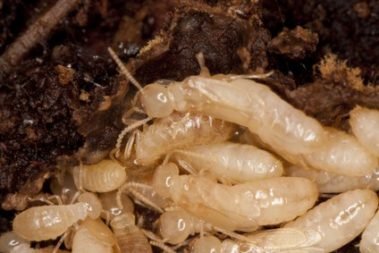
It’s worth being clear about what carpenter bees are not, since the word “borer” and a hole in wood sometimes leads people to assume termite damage. Carpenter bees don’t eat wood the way termites do, they excavate it to create a nesting chamber and discard the sawdust, which is why you’ll find a small pile of fine sawdust directly below an active hole. Termite damage, by contrast, is usually hidden from view, hollowed-out wood beneath an intact surface, mud tubes along a foundation, and no visible entry holes at all. A structure with carpenter bee holes is dealing with a cosmetic and, over years, a moderate structural concern in specific boards. A structure with termites is dealing with an active infestation that can compromise framing far more broadly and generally needs a completely different treatment approach.
Why they pick the wood they pick
Carpenter bees aren’t chewing through wood for food the way termites are. A female bores a tunnel to lay eggs, provisioning each chamber with a ball of pollen for the larva that hatches there. She prefers softwood that’s already weathered, unpainted, and exposed to the elements, which is why deck railings, fascia boards, eaves, and untreated fence posts are such common targets. A single tunnel typically runs a few cm straight in before turning to follow the wood grain, and a female may extend that same gallery 15 cm or more over a season if it goes undisturbed.
Telling an active hole from an old one
Fresh sawdust directly beneath a hole is the clearest sign of current activity, since wind and rain scatter old sawdust within a week or two. A hole with a smooth, clean-edged opening and no debris around it is more likely from a prior season. Listening for a faint buzzing sound with your ear near the wood on a warm day can also help confirm activity, since a larva or newly emerged adult inside an active gallery is often audible up close. Checking in early spring, right as overwintering adults become active, is the best time to get an accurate read on which holes from last year are being reused.
Natural ways to deter them
- Paint or stain exposed wood. Carpenter bees strongly prefer bare, untreated wood, and a painted or well-sealed surface is far less appealing to them.
- Apply citrus or almond oil to vulnerable wood surfaces in early spring, before nesting activity picks up. Bees tend to avoid the scent.
- Fill old holes with wood putty once you’re confident the tunnel is no longer active, since abandoned holes are often the first ones reused the following year.
- Hang a few decoy nests nearby. Carpenter bees are somewhat territorial and may avoid areas that already appear occupied.
- Replace consistently targeted boards with pressure-treated or composite alternatives where practical, since eliminating the preferred material is more durable than repeated yearly deterrent treatments on the same untreated board.
Timing matters
Most carpenter bee activity starts in spring when overwintering adults emerge and begin new or reused tunnels. Treating exposed wood before that window, rather than after you’ve already found holes, is far more effective. If you do need to treat an active tunnel, a light application of diatomaceous earth dusted into the entrance can help, but it should be targeted at active holes rather than applied broadly, since carpenter bees are pollinators and a scattershot approach does more harm than the problem warrants. By late summer, that season’s larvae have matured into adults that overwinter inside the same tunnels, so holes that look quiet in fall aren’t necessarily empty.
Are carpenter bees worth protecting?
Carpenter bees are decent pollinators, and some regions actively discourage killing them outright for that reason. The EPA’s pollinator protection guidance reflects this same balance, encouraging property owners to manage pest pressure without unnecessarily harming pollinator populations where a targeted, less destructive option exists. The goal with most natural methods isn’t eradication, it’s redirection: making your deck and fence less appealing while leaving the bees alone to do their actual job elsewhere in the yard. That’s part of why painting and oil treatments are the first line of defense rather than an insecticide, since they change the bee’s preference without wiping out a pollinator that isn’t otherwise causing trouble.
Regional notes
In the US and Canada, carpenter bee activity is heaviest across the South, Mid-Atlantic, and parts of the Midwest, wherever there’s a good supply of exposed softwood decking and older wood siding. In the UK, carpenter bees are far less common than in North America, and most “boring bee” reports there turn out to be solitary mining bees in soil rather than wood-boring carpenter bees, which is worth ruling out before treating a deck that may not actually be the problem. In Australia, several native carpenter bee species are active, particularly in warmer coastal regions, and behave similarly to their North American relatives in terms of nesting preference.
What not to do
Plugging an active hole without treating it first just seals a bee inside a wall or board, where it will often chew a second exit rather than dying quietly. Broad-spectrum spraying of the whole deck or fence line is also a mistake: it kills pollinators that had nothing to do with the damage and rarely reaches bees already sealed inside a tunnel. And swatting at hovering males, however satisfying, does nothing, since they’re the harmless half of the pair and the females doing the actual boring are usually elsewhere.
When the damage is spreading
If you’re finding new holes every year, or the wood around existing tunnels is starting to soften or crumble, that’s a sign the colony has grown beyond what surface treatments will fix. Tunnels that run deep enough to intersect can also let rainwater in, which invites rot and, eventually, carpenter ants looking for softened wood. Call us at 1-844-783-4821 and our pest professionals can assess how far the damage goes and treat it without going after every bee in the yard.
DIY vs. calling a professional
A handful of holes on an easily reachable deck rail or fence post is a reasonable DIY project: dust the active holes, fill them once quiet, and repaint or reseal the wood. Where it’s worth bringing in a professional is when holes are spread across hard-to-reach eaves or a second-story fascia board, when the same boards have been reused for several consecutive seasons and structural softening is starting to show, or when you’re not fully confident distinguishing carpenter bee damage from termite or wood rot activity, since treating the wrong problem wastes both time and money. A pest professional can also advise on whether a heavily damaged board needs replacement rather than just repair, which is a call that’s easy to get wrong without experience assessing wood condition.
Materials that help before holes even appear
Beyond paint and oil treatments, a few structural choices reduce carpenter bee pressure before a season even starts. Vinyl or aluminum trim on fascia boards and soffits removes the wood target entirely in the areas most exposed to weather. Composite decking material, increasingly common in newer builds, isn’t appealing to carpenter bees the way natural softwood is, so a deck rebuild is a reasonable moment to factor this in even if pest pressure wasn’t the primary reason for the choice. For homeowners keeping natural wood for aesthetic reasons, a higher-quality exterior wood stain reapplied every two to three years, rather than a one-time application left to wear down, keeps the deterrent effect active far longer than most people assume from a single coat.
A few common questions
Will carpenter bees come back to the same spot every year? Often, yes. An unfilled, untreated tunnel is an easy reuse for the next generation, which is why closing up old holes matters as much as deterring new ones.
Do carpenter bees damage pressure-treated wood? Rarely. They strongly prefer bare or weathered softwood over treated lumber, which is part of why fences and decks built with treated wood see far less activity.
Is it safe to have kids or pets around an active nest? Generally yes, since females rarely sting without being handled, but keep an eye on anyone with a known bee sting allergy and avoid disturbing holes directly.
How much does it typically cost to repair carpenter bee damage? A small number of holes filled and refinished is a modest, largely material cost most homeowners can handle themselves. Repair costs rise significantly if multiple boards need structural replacement, which is one more reason catching and treating activity early, before years of reuse compound the damage, matters.