Office buildings have a pest problem homes rarely deal with: a rotating cast of people, none of whom feel individually responsible for the break room fridge or the cardboard piling up near the loading dock. That structural gap is where most commercial pest issues start, and it’s why a plan built for a single-family home doesn’t translate cleanly to a 3,700-square-metre office or a strip mall storefront.

The break room is ground zero
Shared kitchens accumulate crumbs, spills, and forgotten leftovers faster than any single household kitchen, simply because more people use them and fewer feel ownership over cleaning them. Ants and cockroaches both key in on this fast, and a fridge with one unlabeled container of something rotting in the back can be enough to start attracting activity within a week or two. A cleaning schedule that includes wiping counters and emptying trash nightly, not just when it looks full, removes the draw before it becomes a problem. It helps to post a simple end-of-day checklist near the sink, since relying on general goodwill rarely holds up once a building has more than a handful of tenants sharing the space.
Deliveries are an entry vector
Cardboard boxes are one of the most common ways cockroaches and other pests travel into commercial buildings, often riding in on shipments from a warehouse that already has an issue. German cockroach egg cases, in particular, are small enough to go unnoticed inside a folded box flap. Breaking down and removing boxes promptly, rather than letting them stack in a storage room, cuts off a route that a lot of facility managers don’t think about. If your building takes regular freight or supply deliveries, it’s worth designating a receiving area away from the main workspace where boxes get inspected and broken down before anything moves further into the building.
Loading docks and building envelope
Gaps under dock doors, damaged door seals, and unscreened HVAC penetrations are the physical entry points most commercial pests use. A building envelope walk-through, checking door sweeps, weatherstripping, and utility penetrations, catches most of these before they matter. Dock levelers and dock plates are worth a second look too, since the seal underneath them wears out faster than most people expect given how often they’re in motion. Roof-mounted HVAC units are another commonly missed spot; the conduit and refrigerant line penetrations around them are rarely sealed as tightly as the rest of the roof, and they sit above a false ceiling that pests can travel through undetected for months.
Storage rooms, file rooms, and IT closets
These are the spaces nobody visits daily, which makes them attractive to pests looking for undisturbed shelter. Cardboard document boxes and old furniture stacked against a wall create both a hiding spot and, for rodents, nesting material. A quarterly walkthrough of storage areas, even a five-minute one, tends to catch droppings, gnaw marks, or shed insect wings long before the problem shows up somewhere staff will notice it.
Rodents in particular are drawn to IT closets and server rooms for a less obvious reason: the warmth given off by equipment and the insulation value of bundled cabling. Beyond the obvious data and equipment risk, gnawed wiring in these spaces is a genuine fire hazard, and because the space is climate-controlled and rarely disturbed, an infestation can go unnoticed far longer than it would in a normal office area. A visual check behind server racks and along cable runs during the quarterly walkthrough is worth the extra few minutes it takes.
Bed bugs are a growing office concern too
Bed bugs aren’t a break room or loading dock problem, they’re a people problem, arriving in backpacks, coats, and personal belongings rather than through a building’s physical entry points. A single employee unknowingly carrying a few bed bugs from home can introduce them to an office chair, coat closet, or soft seating area in a common space, where they can persist for months without anyone realizing it. Unlike most commercial pests, bed bugs don’t respond to routine sanitation or sealing exterior gaps, since the introduction point is a person, not a crack in the building envelope. If an employee reports bites or you find small reddish-brown insects near seams of upholstered furniture, treating it quickly and discreetly matters, both for containment and for how it’s handled with staff. The EPA’s guidance on bed bug management emphasizes early identification and professional treatment over DIY sprays, which tend to scatter a population into new hiding spots rather than eliminating it.
Servicing without disrupting the workday
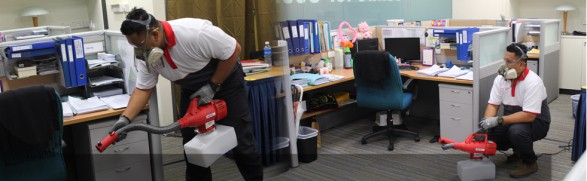
Commercial accounts usually need treatment scheduled around business hours, whether that’s early morning before staff arrive, or evenings after close. Natural and low-odor treatment methods matter more in an office setting than almost anywhere else, since staff are back at their desks within hours, not days. This matters even more in shared or multi-tenant buildings, where treating one unit’s pest problem shouldn’t mean the neighboring business smells it through a shared HVAC system.
Documentation matters as much as the treatment itself
Health inspectors, landlords, and corporate compliance teams all want to see a paper trail, not just a clean-looking space. A service log that records what was found, what was treated, and when the next visit is scheduled gives you something concrete to hand over during a lease audit or health inspection, rather than scrambling to reconstruct a history from memory. This is especially important for food service tenants, medical offices, and any facility that operates under a health code, where a gap in documentation can be treated the same as a gap in actual pest control.
What good commercial pest management includes
- A monitoring and documentation trail, useful for health inspections and lease compliance
- Scheduled visits sized to your actual risk level, not a one-size calendar
- Treatment methods that don’t require evacuating the space or leaving strong odors behind
- A dedicated pest professional as your point of contact, able to respond fast if something turns up between visits
- Seasonal adjustments, since rodent pressure in the fall and ant or wasp activity in the summer call for different attention
What tends to go wrong without a plan
The most common mistake we see in commercial accounts isn’t neglect, it’s treating pest control as a reactive line item instead of a scheduled part of building maintenance. By the time staff are reporting sightings, a cockroach or rodent population has usually had weeks to establish itself in wall voids or under equipment, which makes the eventual treatment more disruptive and more expensive than it needed to be. A monitoring program that catches early activity, before it’s visible to staff or customers, is almost always cheaper over a year than a single emergency callout.
What this costs and how often service should happen
Commercial pest management is typically priced by square footage, building type, and risk level rather than a flat rate, a food service tenant or a warehouse with regular freight traffic needs more frequent attention than a standard office suite with no kitchen beyond a break room. Monthly service is standard for restaurants, grocery, and other food-handling businesses that operate under strict health code requirements, while general office and light retail space often does fine on a quarterly schedule with monitoring in between. Most pest management companies offer a free no-obligation quote after walking the property, since an accurate plan depends on square footage, the number of entry points, and what’s actually stored on-site. It’s worth treating this as a fixed line item in the facilities budget rather than an occasional emergency expense, since consistent scheduled visits are almost always cheaper over a year than the cost of an established infestation plus the reputational and compliance risk that comes with it.
Seasonal patterns in a commercial building
Rodent pressure on office buildings ramps up in fall, the same as it does for homes, as mice and rats look for a warm, enclosed space ahead of colder weather. A commercial property with a loading dock and multiple utility penetrations gives them more options than a typical house, which is why fall is worth a dedicated exterior walk rather than folding it into a routine visit. Summer brings more ant and wasp activity around dumpster enclosures and any exterior seating areas, while spring is the season to check for new gaps that formed over winter as materials expanded and contracted with temperature swings.
Multi-tenant buildings need a shared plan
In a building with multiple tenants, one unit’s pest problem rarely stays contained to that unit for long. Shared walls, a common HVAC system, or a connected drop ceiling all give pests a route between spaces that individual leases don’t account for. If you manage a multi-tenant property, it’s worth having a building-wide monitoring plan rather than leaving pest control entirely up to each tenant, since a gap in one unit’s coverage becomes everyone’s problem eventually.
Common questions
Who’s responsible for pest control in a leased office space, the landlord or the tenant? It depends entirely on the lease, and this is worth confirming in writing before a problem comes up. In many commercial leases, the landlord handles building-wide issues like the exterior envelope and shared spaces, while tenants are responsible for pest activity specific to their own unit, but the split varies enough that assuming isn’t a safe approach.
How quickly does a commercial pest issue need to be addressed once it’s reported? Fast, ideally within a day or two of a credible report, especially for food service or healthcare tenants operating under health code requirements. A delayed response increases both the size of the eventual treatment and the risk of a compliance issue if an inspector happens to visit in the meantime.
Does a good pest management plan reduce insurance or liability costs? It can. Some commercial property and liability policies factor in documented pest prevention programs, and a consistent service log is useful evidence of due diligence if a pest-related claim or dispute ever comes up, regardless of whether it directly lowers premiums.
Our pest control contractors work with facility managers across office, retail, and light industrial spaces to build a plan that fits how the building actually operates, with documentation you can hand to an inspector or a landlord without scrambling. Call 1-844-783-4821 to set up a commercial assessment.