
Termite treatment costs vary more than most homeowners expect, and the reason usually isn’t the company you call. It’s how much the situation has progressed before anyone calls at all.
The factors that actually set the price
A few things move the number more than anything else:
- How far the colony has spread. A localized infestation caught in a crawlspace or a single sill plate costs far less to address than one that’s moved through multiple structural members.
- The treatment method. Spot treatments and bait station systems are generally less expensive than a full liquid barrier around the foundation, and both are almost always less expensive than tenting.
- Your foundation type and home size. Slab homes, pier-and-beam, and basement foundations each require different application approaches, and square footage affects material volume for barrier treatments.
- Accessibility. Additions, attached decks, and finished basements that block access to the foundation perimeter can add labor time.
- Species. Subterranean colonies are usually addressed with soil or bait treatments around the structure, while a drywood infestation confined to an isolated piece of framing may only need localized treatment, though a widespread drywood problem can call for whole-structure fumigation, which changes the cost picture entirely.
What a Termite Inspection Actually Involves
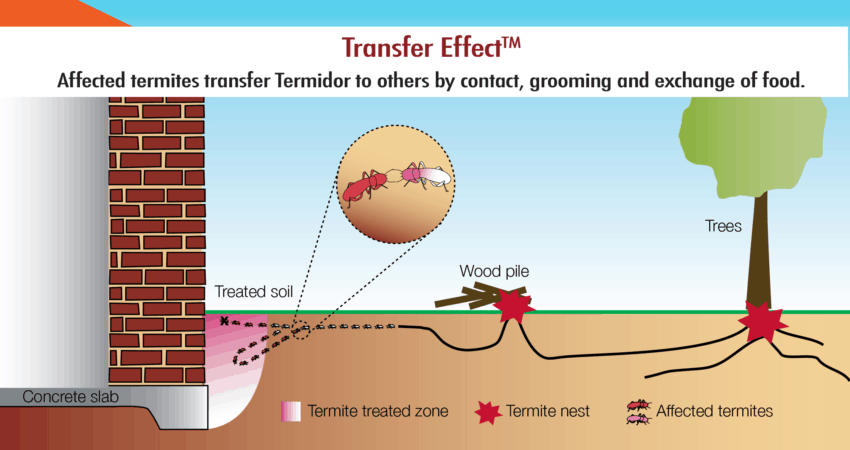
A proper inspection before a quote isn’t just a walk around the yard. It typically includes probing exposed wood with a screwdriver or awl to check for softness or a hollow sound, checking moisture levels around the foundation with a meter, since damp wood and soil are what subterranean termites need to survive above ground, and looking specifically at sill plates, crawlspace framing, and any wood-to-soil contact points like deck posts or porch steps where termites have direct access without needing to build a mud tube at all. A thorough inspector also checks the soil grade around the foundation, since soil piled too high against siding, a common issue after landscaping work, can bury the treated zone and give termites a bridge over it.
Why the Same-Looking Job Can Price Differently
Two houses with an identical mud tube on the foundation can end up with very different quotes, and it’s rarely because one company is padding the bill. A slab home with the tube visible at the exterior is a straightforward barrier job. The same tube on a home with a crawlspace and an inaccessible interior pier can mean more time spent just getting equipment into position before any treatment happens. Older homes with additions built at different times sometimes have multiple foundation types under one roof, and each section may need its own approach. Previous treatment history matters too: a home that already has an existing liquid barrier from a prior owner might only need a partial retreatment at vulnerable spots, while a home with no treatment history and an active colony needs the full scope. If you’re buying a home and a termite inspection turns up past treatment, ask for documentation of what was used and when, since that changes what a new company needs to quote for continued protection versus starting over.
Where the real savings are
The single biggest cost lever isn’t negotiating a lower rate. It’s timing. A colony that’s been active for six months is a different job than one that’s been active for three years. Mud tubes on a foundation wall, discarded wings near window sills after a swarm, or a hollow sound when you tap baseboard trim are worth a call the week you notice them, not the month you get around to it. Waiting even a single season can turn a localized spot treatment into a job that needs a full perimeter barrier, and the price difference between those two is significant.
Monitoring costs less than remediation
Ongoing bait station monitoring is inexpensive compared to structural remediation, and it catches activity before it becomes a repair problem. A monitoring program typically involves a handful of stations placed around the perimeter and checked on a set schedule, usually a few times a year. If your property has had termites before, or you’re in a region where subterranean termites are common, a monitoring program is usually the cheapest insurance you can buy.
Ask what you’re actually paying for
Not every property needs a full perimeter treatment. Some need a targeted application at the specific entry point. A licensed fumigator who inspects before quoting, rather than quoting a standard package over the phone, is more likely to right-size the treatment to the actual problem instead of the biggest number on the price list. Be wary of any quote given without someone actually looking at the foundation, the soil grade, and the interior signs first.
What Homeowners Often Get Wrong About Cost
- Assuming the cheapest quote is the best value, when it may reflect a smaller scope than what the problem actually requires.
- Assuming a higher price always means more thorough work, rather than a bigger service area or a less efficient method for that particular home.
- Skipping the inspection step to save time, which usually means the first quote is a guess rather than an assessment.
- Treating a DIY store-bought bait station as equivalent to a monitoring program run by a pest control contractor, when placement and species identification matter more than the product itself.
Warranty and Retreatment Terms Worth Asking About
Termite treatment quotes vary not just in price but in what happens if activity returns. Ask specifically whether a warranty covers retreatment only, or retreatment plus damage repair, since those are very different levels of coverage and priced differently for a reason. Ask how long the warranty runs, whether it renews annually with a monitoring fee, and what would void it, some warranties require the annual inspection to stay valid, and skipping one can lapse coverage without you realizing it until you need it.
A Regional Note
Subterranean termite pressure is heaviest across the southern and southeastern US, much of the Gulf Coast, and coastal British Columbia, where soil moisture stays high for much of the year. Drywood termites are more of a concern in warmer coastal areas of the US, Australia, and parts of the UK’s milder regions, where isolated furniture or framing infestations are more common than a colony working up from the soil. Knowing which pressure your region faces helps set expectations before an inspection even happens.
A Few Common Questions
Is a termite treatment a one-time expense? For a bait or monitoring program, no, it’s an ongoing service with periodic checks. For a liquid barrier, the initial application is often the bulk of the cost, though most companies recommend periodic re-inspection since barriers can degrade over years. Fumigation for drywood termites is typically a single, larger expense that covers the whole structure at once.
Does homeowner’s insurance cover termite damage? Almost never. Termite damage is generally considered a preventable maintenance issue rather than a sudden, covered event, which is exactly why catching activity early matters so much financially. The cost of treatment is almost always smaller than the cost of repairing what an unchecked colony does to framing, subflooring, or trim.
Do I need a treatment if I’ve never seen termites? If you’re in a region with regular subterranean pressure, or you’ve had a prior infestation anywhere nearby, a monitoring program is worth the modest ongoing cost even without visible activity, since the earliest signs are often underground and out of sight until a swarm happens.
Should I get quotes from more than one company? For anything beyond a small monitoring program, yes. Because so much of the price depends on an in-person assessment of colony extent, foundation type, and accessibility, two companies can reasonably land on different numbers for a legitimate reason, comparing both the price and what’s actually included, inspection depth, warranty terms, treatment method, tells you more than the number alone.
DIY vs. Calling a Professional
Store-bought termite bait stakes and spot treatments can slow a very small, newly discovered problem, but they rarely reach an established colony, especially a subterranean one connected to a much larger network in the surrounding soil that a homeowner can’t see or access. DIY treatment also makes it harder to know whether the problem is actually resolved or just less visible for a while, since without professional-grade monitoring tools there’s no reliable way to confirm the colony has been eliminated rather than simply relocated to another part of the structure. For anything beyond a single isolated piece of furniture with drywood damage, professional assessment is worth the cost specifically because misjudging the scope is what turns a moderate repair into a major one.
Most liquid barrier and bait installations are completed in a single day for an average-sized home, though bait station programs continue with periodic checks afterward rather than ending after that first visit. Fumigation for a whole-structure drywood problem typically requires vacating the home for one to three days depending on structure size, which is worth factoring into scheduling around work, school, or travel.
Our approach
We assess the extent of activity first and recommend the least invasive treatment that will actually solve it, using natural-first methods where they’re effective. If the problem isn’t fully resolved, we come back at no charge until it is. There’s no contract holding you to future service you don’t need. If you’re seeing signs of termite activity, call us at 1-844-783-4821 and we’ll walk you through what we’re seeing and what it will take to fix it.