Services
Pest Inspections
A room-by-room, crawlspace-to-attic inspection that tells you exactly what's active on your property, and what to do about it, before you sign a lease, close on a house, or spend another night wondering what's making that noise in the wall.
Natural, guaranteed pest control — free no-obligation quotes, no contract, safe around kids and pets.
Signs You Need This
How to tell it's time to call
Book an inspection if you're closing on a property and want more than the standard WDO checkbox on a real estate report, or if you've noticed something specific but can't identify it: pencil-eraser-sized droppings along a baseboard, discarded termite wings collecting on a windowsill after a warm rain, small round exit holes in a fence post or deck board, a scratching or scurrying sound in the wall after dark, or a musty, damp smell coming from a crawlspace or basement that wasn't there last season. It's also worth scheduling one seasonally in humid regions where termite swarms follow the first warm rains, or before winter in colder climates when rodents start looking for a way indoors. If a neighbor just had an active infestation treated, that's reason enough to get ahead of it rather than wait for your own signs to show up.
The Full Picture
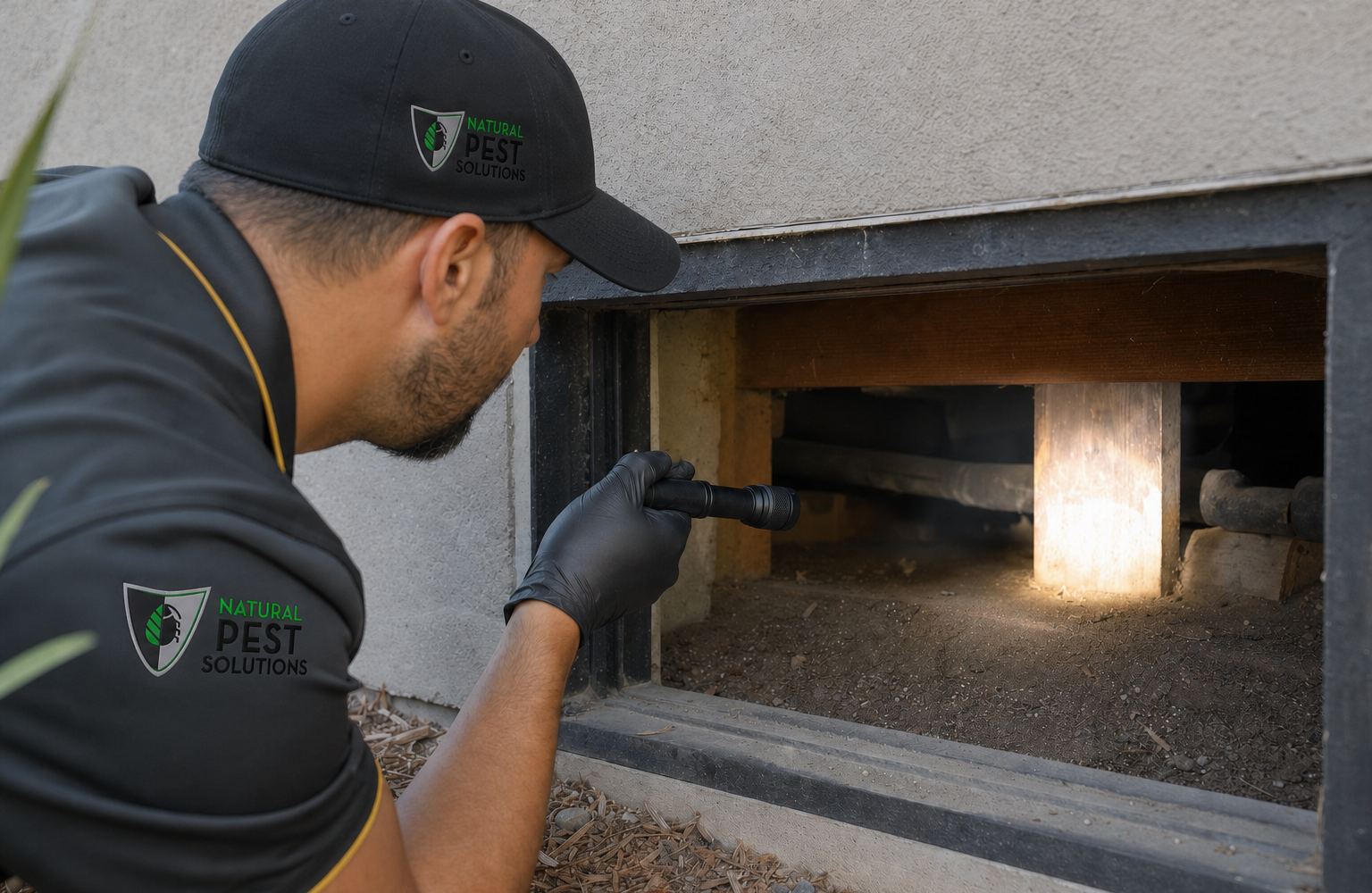
An inspection isn't a quick look with a flashlight from the doorway. Our technicians get into the spaces most people never check: crawlspaces, attic eaves, the gap behind the water heater, weep holes along a brick veneer, the plumbing penetrations under a kitchen sink. In older homes with stone or block foundations, that means checking mortar joints and sill plates for wood-destroying organisms. In newer slab construction, it means tracing expansion joints and utility entry points where ants and rodents actually get in. Every inspection ends with a written report: what we found, where we found it, and photos, so you're not taking our word for it.
Pest inspections are a paid diagnostic service, not a sales pitch dressed up as a freebie, and we tell people that upfront. If the inspection turns up an active issue and you have us treat it, we start with the least invasive, most targeted method that will actually solve the problem, not a blanket spray because it's faster for us. And if that treatment doesn't hold, we come back and address it at no additional charge. No contract required to get that guarantee. You can book us for a single inspection, a one-time treatment, or ongoing service, and walk away anytime.
Our Approach
An exterminator walks the full property inside and out, checking the spots pests actually use to get in and settle down: foundation cracks, roofline and soffit gaps, garage door thresholds, dishwasher and washing machine hookups, and any wood-to-soil contact around decks or porch steps. We use a moisture meter in crawlspaces and basements since damp wood and high humidity are what draw termites and carpenter ants in the first place, and we check for those conditions even if we don't find an active pest that day. Everything goes into a written report with our findings and recommendations, so if we do suggest treatment, you know exactly why, and you can decide with actual information instead of pressure. Any treatment that follows starts natural-first and backed by our guarantee: if it's not gone, we're back at no extra cost to make it right.
Satisfaction Guaranteed
If it's not gone, we come back — free.
Safe & Humane
Natural methods, safe around kids and pets.
No Contracts
Stay because it works — not because you're locked in.
The Details
Treatment Options & Products We Use
Treatment Options
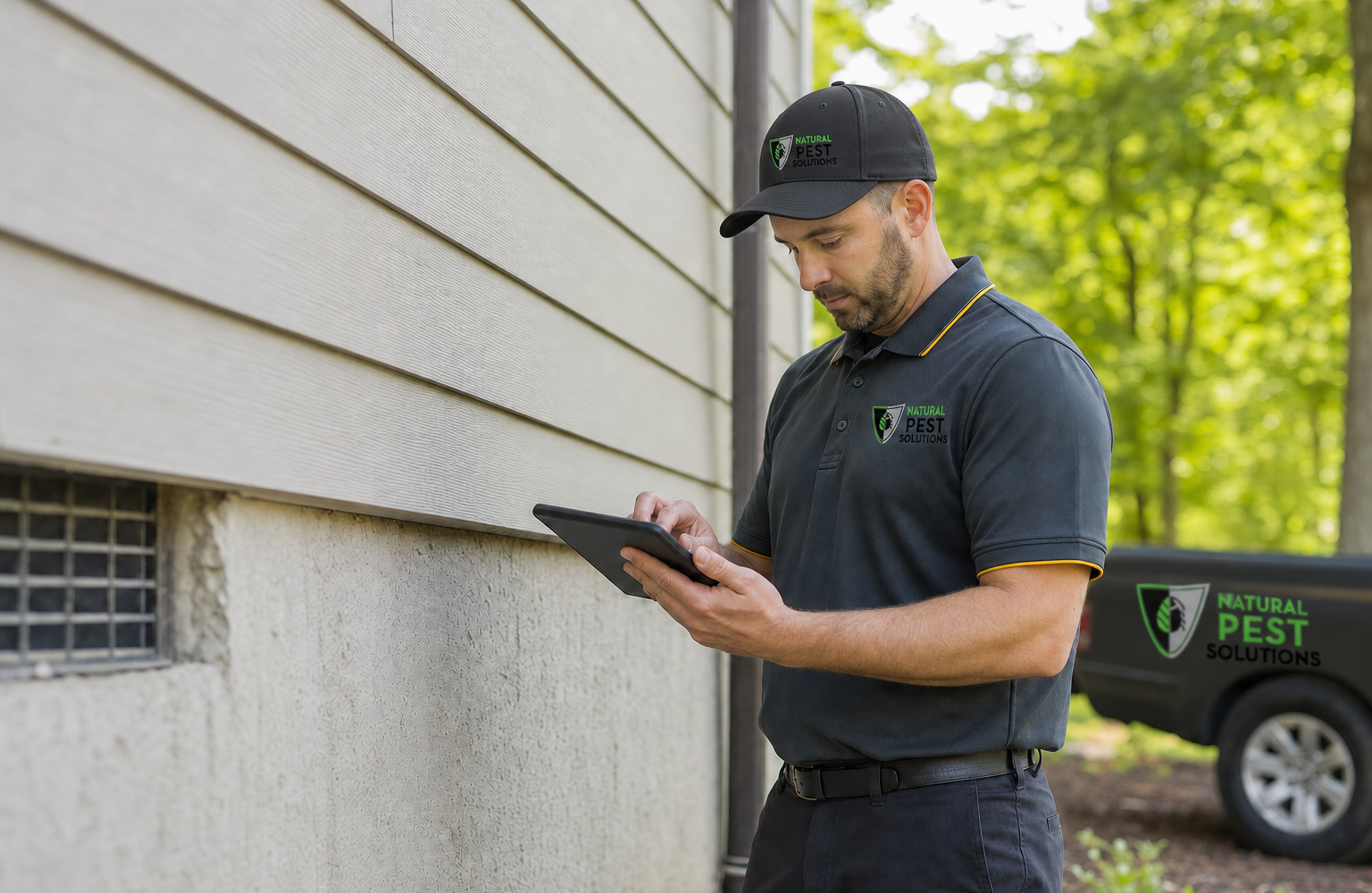
An inspection follows a set sequence so nothing gets skipped, moving from the exterior perimeter inward and finishing with a written summary of what was found.
- Exterior perimeter: siding, vents, utility line entry points, and grading that directs water (and pests) toward the foundation
- Attic: insulation disturbance, rafter tips, gable and ridge vents, and any staining that signals a roof leak pests could be using as a water source
- Crawlspace or basement: sill plates, floor joists, support posts, and vapor barrier condition, all checked for the kind of moisture and wood contact that draws termites and beetles
- Interior: baseboards, window and door casings, cabinet toe-kicks, and the areas around water heaters and furnaces where warmth and humidity concentrate
A typical single-family inspection runs 45 minutes to just over an hour, longer for larger homes, homes with limited crawlspace access, or properties with an existing history of activity. Each finding gets a severity note, active infestation, conducive condition (like wood-to-soil contact or a plumbing leak), or no evidence found, and those notes are what the treatment recommendation is built from. A property with only conducive conditions might just need exclusion work; one with active activity gets a targeted treatment plan scoped to what's actually there.
We recommend an inspection annually as routine prevention, at the time of a home purchase regardless of what a standard WDO report covers, and again 30 to 60 days after any treatment to confirm the issue didn't come back before it has a chance to spread further.
Products & Methods We Use
Inspections lean on diagnostic tools that find activity hidden behind walls, under floors, or inside framing before it becomes visible damage.
- Moisture meters to flag the damp wood and elevated humidity that draw termites and carpenter ants before any structural sign appears
- Acoustic and infrared detection devices that pick up termite feeding activity inside wall voids and framing without needing to open them up
- Borescopes for a direct look inside wall voids, soffits, and other enclosed spaces that would otherwise require cutting into drywall
- Motion-activated cameras placed in attics, crawlspaces, or along suspected rodent paths to confirm activity and identify the species when droppings or sounds alone aren't conclusive
These tools don't replace a hands-on inspection, they extend it into spaces a flashlight and a trained eye can't fully reach on their own, which is part of why a proper inspection takes real time.
What Customers Say
Real reviews from our Google Business Profile.
“I am really pleased with the guys at Natural Pest Solutions, they got rid of my rodent problem quickly and those mice have not been back. I highly recommend these guys, they are the best pest control company around.”
Shawn Kern — Google review
View on Google →“I really am impressed with the great customer service and how quickly they came to help me with my rodent problem. After doing a pest inspection they found that the problem was much worse than I expected, but the guys at Natural Pest Solutions came to my rescue and got rid of all these nasty pests in my home.”
Phillip Pond — Google review
View on Google →“Natural Pest Solutions just finished a job at my house. They explained everything in detail and answered every question. On time, professional, and neatly attired. Highly recommended!”
William Morgan — Google review
View on Google →Questions
Frequently Asked About Pest Inspections
How much does a pest inspection cost?
Cost depends on property size and how thorough an inspection you need — attic, crawlspace, and full perimeter checks take longer than a walk-through. Most standalone inspections run in the low-to-mid hundreds, and if you move forward with treatment afterward that fee is often applied toward the job.
Is a pest inspection the same as a WDO report for a home sale?
Not exactly — a standard WDO (wood-destroying organism) checkbox report covers termites for a real estate transaction, while a full inspection here also covers rodents, ants, spiders, and general entry points, with photos and a written report. If you're buying or selling, ask specifically whether you need the WDO form for the lender or a broader property inspection, since they serve different purposes.
Can I inspect for pests myself instead of hiring a pest control contractor?
You can check the obvious spots — baseboards, window sills, under sinks — but a real inspection means getting into crawlspaces, attic eaves, and wall penetrations most homeowners never access, plus using a moisture meter to catch damp conditions that draw termites before there's visible damage. A trained eye also tells the difference between old damage and something currently active.
How long does a pest inspection take?
A thorough inspection of an average single-family home typically takes 45 minutes to an hour and a half, longer for larger properties or homes with crawlspaces and attics. You'll walk away with a written report the same day, not a callback a week later.
What are signs I need a pest inspection right now?
Discarded termite wings on a windowsill after a warm rain, pencil-eraser-sized droppings along a baseboard, scratching in the walls at night, small round exit holes in a deck board or fence post, or a musty smell in the crawlspace are all reasons to book one rather than wait. If a neighbor just had an active infestation treated, that's reason enough on its own.
Is a pest inspection safe for kids and pets, or do I need to leave the house?
A standard inspection doesn't involve any chemical treatment, so there's nothing to keep kids or pets away from — a pest controller is just walking the property and checking hard-to-reach spots. If the inspection turns something up and you move forward with treatment, that's a separate step, and we'll tell you upfront whether you need to clear the area for it.
Learn More
Trusted resources on this topic
Guidance from health and regulatory bodies. In Canada, see Health Canada.
- EPA: Integrated Pest Management ↗How IPM prevents pests with the least risk to people.
- EPA: Controlling Pests ↗U.S. guidance on choosing and using pest control safely.
- Health Canada: Pesticides and Pest Management ↗Canadian guidance on pest control products.
Keep exploring
Related pest control services
Areas we serve
- Pest control in Richmond
- Pest control in Salmon Arm
- Pest control in San Tan Valley
- Pest control in Scottsdale
- Pest control in Silsbee
- Pest control in Surrey
- Pest control in Tempe
- Pest control in Tucson
- Pest control in Vancouver
- Pest control in Vernon
- Pest control in West Kelowna
- Pest control in Abbotsford
- Every location we serve
Ready to deal with it, for good?
Talk to a real expert — no pressure, no toxic chemicals, no contract required.
Recognized by the organizations that set the standard