
Termites get treated as their own category in the pest industry, and there’s a reason: the stakes are structural, the treatments are more involved, and the mistakes are expensive. Here’s how termite treatment fits under the pest control umbrella, and why it isn’t just “pest control, but for termites.”
Why termites are handled differently
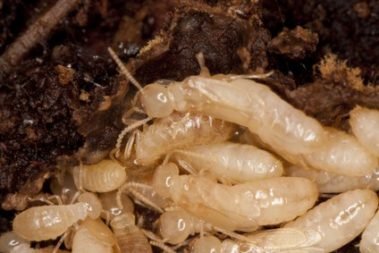
Most pest issues, ants, spiders, occasional invaders, are surface-level: something’s in a space it shouldn’t be, and treatment addresses that space. Termites work below the surface, literally, moving through soil and wood in colonies that can go undetected for years. By the time you see mud tubes on a foundation wall or blistered paint on a windowsill, the colony has usually been active for a while. A mature subterranean colony can number in the hundreds of thousands and forage across a territory spanning multiple properties, which is part of why termite treatment gets planned around the whole structure rather than a single visible entry point.

What termite treatment actually involves
- Inspection and identification: subterranean, drywood, and dampwood termites behave differently and call for different treatment strategies, so knowing which one you have changes the plan. Subterranean termites need soil contact and build mud tubes to travel above ground, while drywood termites live entirely inside the wood they’re consuming and don’t need soil contact at all. Dampwood termites are less common in most homes and usually point to a chronic moisture problem, like a leaking pipe or rotting sill plate, rather than a general infestation risk.
- Liquid soil treatments or baiting systems: liquid termiticides create a treated zone around the structure, while bait stations rely on worker termites carrying a slow-acting substance back to the colony. Within liquid treatments there’s also a distinction between repellent products, which termites avoid, and non-repellent products, which termites can’t detect and walk through, then carry back to the colony on their bodies, which tends to affect a larger share of the population over time.
- Wood and structural treatment: for drywood termites already in framing or furniture, targeted spot treatment, sometimes foam injected directly into wall voids or infested wood, may be needed alongside or instead of soil work. For new construction or additions, borate treatments applied directly to framing lumber before drywall goes up are a common preventive step that isn’t really an option once a wall is closed up.
- Monitoring: termite work isn’t a one-and-done spray; bait stations get checked on a schedule, and soil treatments get reassessed as the property settles or is disturbed by landscaping and construction
How long treatment actually takes
This is where expectations need to be realistic. A liquid soil treatment can start reducing activity within days to a couple of weeks, since it works as a barrier that termites contact directly. Bait systems work on a longer timeline, often taking two to four months to noticeably reduce colony activity, because the mechanism depends on foraging workers finding the bait, feeding on it, and carrying it back to share with the rest of the colony including the queen. Neither approach is faster or slower across the board, it depends on colony size, soil conditions, and how the property is laid out, but anyone promising a termite colony gone in a week with a bait-only approach isn’t being straight with you.
What actually drives the cost
Termite treatment pricing varies more than most other pest services because so much depends on the property itself. Linear footage of foundation is the biggest factor for liquid soil treatments, since the treated zone runs the full perimeter, a sprawling single-story home costs more to treat than a compact two-story one with the same square footage. Accessibility matters too: a slab-on-grade home with a crawlspace or basement is more straightforward to treat than one with an attached deck, patio, or addition built over the original foundation line, since those areas often need to be drilled through or worked around. Colony type changes the math as well, drywood spot treatment for a single piece of infested framing costs far less than a whole-structure fumigation, but if drywood activity is scattered across multiple rooms, fumigation sometimes ends up cheaper than treating each spot individually. Warranty terms are the other piece people overlook: a renewable annual warranty that includes retreatment and covers repair costs if termites return typically costs more upfront than a one-time treatment with no warranty, but for many homeowners the difference is worth it given how much repair work can run if a colony re-establishes.
DIY monitoring vs. calling a professional
There’s a reasonable place for do-it-yourself work in termite prevention, just not in active treatment. Homeowners can install consumer-grade monitoring stakes around the foundation, keep wood-to-soil contact eliminated, and do a visual check for mud tubes and discarded wings each spring, and that kind of ongoing awareness genuinely helps catch a problem early. What DIY approaches consistently fail to do is eliminate an established colony. Store-bought termiticides aren’t formulated at the same concentration as professional-grade non-repellent products, and without proper equipment it’s nearly impossible to treat a full foundation perimeter or inject foam deep into a wall void correctly. The other risk with DIY treatment is a false sense of resolution: spraying visible activity and seeing it stop for a few weeks doesn’t mean the colony is gone, and colonies that go quiet after a partial treatment often resume once the termiticide breaks down. If you’re dealing with anything beyond routine monitoring, bringing in a licensed fumigator for the actual treatment and keeping your own eyes on it between visits is the combination that tends to work.
Where natural methods fit
Termite treatment is one area where we’re upfront about limits: for an active, established colony, botanical or “natural-only” treatments generally aren’t strong enough to stop structural damage on their own. What we do prioritize is choosing the least invasive effective method, targeted baiting over broad soil-wide chemical saturation where it’s appropriate, and pairing any treatment with the moisture and wood-to-soil contact fixes that made your property attractive to termites to begin with. Reducing standing water near the foundation, fixing gutters that dump water against the slab, and keeping mulch and firewood off the house all matter as much as the treatment itself.
Regional risk varies more than people expect
Termite pressure isn’t uniform. The southeastern and Gulf Coast US, along with much of Australia, carry some of the highest subterranean termite pressure, often warranting an annual inspection as a baseline rather than an occasional check. Part of that elevated risk in the Gulf Coast comes from Formosan subterranean termites, an especially aggressive species that builds larger colonies and can attack living trees as well as structures, which is why several coastal cities treat them as a distinct, higher-priority concern rather than lumping them in with native subterranean species. Drywood termites are more of a concern in coastal and warmer regions generally. Cooler parts of Canada and the UK see lower overall pressure but aren’t immune, particularly where older wood-frame construction sits close to grade or has a history of moisture issues. Knowing your region’s baseline risk is part of deciding how often an inspection actually needs to happen.
What not to do
Treating a small visible mud tube yourself with a store-bought spray and considering the problem solved is one of the most common and costly mistakes homeowners make, since a mud tube is a travel route, not the colony itself, and destroying a section of it just prompts termites to rebuild a few centimetres away or find another path. Ignoring a wood-destroying-organism report during a home purchase because the damage “looked old” is another common one, since active and old damage can look nearly identical to an untrained eye, and only a proper inspection tells you which one you’re looking at. And delaying treatment to “watch it for a season” rarely saves money, since a colony left alone for months typically costs more to treat and repair after than it would have earlier.
A few common questions
Can I sell a house with a history of termite treatment? Yes, and in many regions a documented treatment history with an active warranty is actually a selling point, since it shows the issue was addressed properly rather than hidden. Do I need a termite treatment if I’ve never seen any signs? Not automatically, but a baseline inspection is worth it in higher-pressure regions, especially before buying a home or after significant landscaping or grading work near the foundation. Will treatment damage my landscaping? A well-planned liquid or bait treatment is designed to minimize disruption, though some soil work near a foundation may require moving mulch or plants temporarily. How often should bait stations be checked once they’re installed? Most systems are checked two to four times a year after the initial monitoring period, though a technician may check more frequently right after installation or if a station shows active feeding. Can termite damage be repaired without redoing the treatment? Repair and treatment are two separate jobs, a contractor can replace damaged wood, but that work should follow, not substitute for, eliminating the colony that caused the damage in the first place.
What to expect from us
If you’ve got visible mud tubes, discarded wings near windowsills, or wood that sounds hollow when tapped, that’s worth a call, not a wait-and-see. We’ll identify the species, explain what treatment actually fits your situation and your property’s construction, and be honest if a bait system will take a few months to fully work rather than promising an overnight fix that doesn’t exist for termites. Our guarantee applies here too: if activity continues after treatment, we come back and address it at no extra cost, because a termite treatment that doesn’t hold isn’t one we consider finished.