
If you’re getting bitten in your yard in broad daylight, well before dusk, there’s a good chance you’re dealing with Aedes albopictus, the Asian tiger mosquito. Originally from Southeast Asia, it’s now established across much of the southern and eastern US, parts of southern Canada, and increasingly in continental Europe with occasional detections in the UK, and it behaves differently enough from common house mosquitoes that generic advice often misses the mark.
What makes this species different
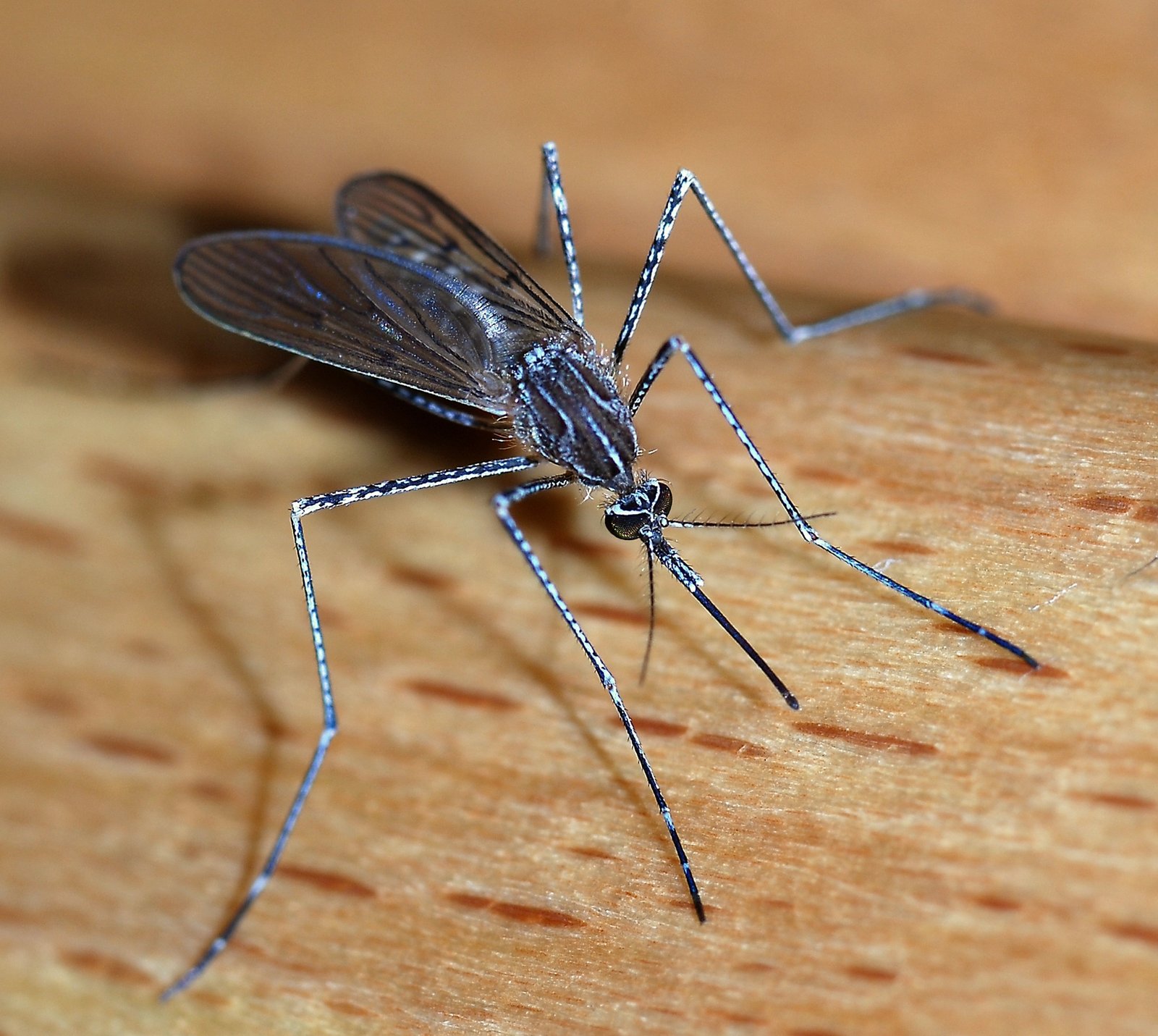
Tiger mosquitoes are aggressive daytime biters, easy to identify by the sharp black-and-white stripe running down the back and legs. Unlike species that mainly bite at dawn and dusk, they’ll come after you at noon on a shaded patio, which is often the first clue people are dealing with this species rather than a more typical backyard mosquito. They’re also low, quiet fliers that tend to attack the ankles and lower legs, which is why bites often cluster there rather than spreading evenly over exposed skin.
The common house mosquito, Culex pipiens, is a useful point of comparison since most homeowners are more familiar with it without realizing it. Culex prefers stagnant ditches, storm drains, and larger neglected water sources, is most active from dusk through the night, and tends to fly higher and bite wherever skin is exposed. Tiger mosquitoes flip nearly every part of that pattern: smaller breeding sites, daytime activity, and a strong preference for the lower body. Homeowners who scout their yard at dusk looking for the source of daytime bites are looking at the wrong time of day entirely, since tiger mosquitoes are usually resting in shaded vegetation by then, not actively laying eggs or feeding.
They breed in almost nothing
This is the part that catches most homeowners off guard. Tiger mosquitoes don’t need a pond or a birdbath. They breed successfully in a bottle cap, a tarp fold, a clogged gutter section, an upturned toy, or the saucer under a potted plant, anywhere that holds even a small amount of water for about a week. A single unmanaged flowerpot saucer can produce dozens of new mosquitoes in a season. The eggs themselves are laid just above the waterline and can survive dry conditions for months, hatching as soon as the container fills again, which is why a spot that looked empty and dry can still be the source of a new wave of bites after the next rain.
Source reduction is the real fix
- Empty and scrub anything that collects water at least once a week, since eggs can stick to container walls even after the water’s gone
- Check tarps, kiddie pools, wheelbarrows, and gutters specifically, since these are the most commonly missed spots
- Fill in low spots in the yard that pool water after rain
- Store items like buckets and watering cans upside down
- Treat any water feature you can’t drain, like a rain barrel, with a Bti dunk rather than leaving it untreated
- Check corrugated drainage pipe and downspout extensions, both hold water along their ridges long after the surface looks dry
- Look inside tire swings, boat covers, and grill covers, all three pool small amounts of water in folds that are easy to miss during a quick yard walk
- Check the tops of trash and recycling bin lids, and any child’s outdoor toy with a hollow base or open top
A useful habit is to do this walk on the same day each week rather than whenever it comes to mind, since the mosquito life cycle from egg to biting adult can complete in as little as seven to ten days during warm weather. A container checked every ten to fourteen days can easily produce a full generation between visits, while a strict seven-day schedule interrupts the cycle before adults emerge.
Why this species has spread so successfully
Tiger mosquito eggs are unusually tolerant of cold and drought compared to most mosquito species, which is part of why the range has expanded so far beyond its original tropical and subtropical territory. The eggs can survive a winter freeze in a northern climate and still hatch the following spring once temperatures and moisture return. That resilience, combined with how little water they need to breed, is why this species has become established in urban and suburban areas that never had a serious mosquito problem before.
Global trade played a role too. The species is widely believed to have spread internationally through shipments of used tires, which hold water in their treads and are shipped in bulk, giving eggs and larvae a ready way to travel long distances and establish in new regions. That same tire-holding-water pattern still shows up locally: an old tire left in a side yard or under a deck is one of the most productive breeding sites a property can have, and it’s often overlooked because nobody thinks of a tire as a water container.
Tiger mosquitoes and disease risk
Because Aedes albopictus is capable of transmitting viruses like dengue, chikungunya, and Zika in parts of the world where those diseases circulate, it gets more attention from public health agencies than a typical nuisance mosquito. Local transmission of these diseases from mosquitoes within the US remains rare, and most bites here result in nothing more than an itchy welt, but the CDC tracks mosquito-borne disease activity because the species’ wide range and daytime biting habits make it a more efficient potential vector than mosquitoes that are only active when most people are indoors. This is one more reason source reduction matters beyond simple comfort, fewer breeding sites means fewer mosquitoes capable of picking up and spreading disease if it’s present in an area.
Why the daytime biting matters
Most people’s mosquito habits are built around dusk, citronella candles at a barbecue, avoiding the yard right at sunset, closing windows before dark. None of that helps against a species that’s most active mid-morning through late afternoon. Kids playing in a backyard after school, someone gardening at midday, a dog let out in the early afternoon, all of these are exposed during exactly the hours most households consider mosquito-free. Adjusting the timing of your own precautions, not just the intensity, is part of actually dealing with this species.
What not to do
Don’t rely on a single fogging treatment and assume the problem is solved. Fogging kills adult mosquitoes present at the time of treatment but does nothing to eggs or larvae sitting in a container you haven’t found, so numbers rebound within a week or two if source reduction isn’t also happening. Don’t assume a large water feature, a pond with fish, moving water, is the culprit either, tiger mosquitoes generally avoid larger bodies of water with predators and current, favoring small, stagnant containers instead, so time spent treating a pond while a bottle cap sits full nearby is time wasted. And don’t overlook a neighbor’s yard, since the mosquito’s short flight range means a source next door can be driving bites in your own yard even if your property is spotless.
Another common mistake is relying only on citronella candles or tiki torches as a primary defense. They can provide a modest, localized reduction in a small area right around the flame, but they don’t do anything to the breeding sites driving the population, and their effect drops off quickly with distance and any amount of breeze. Think of them as a minor supplement to source reduction, not a substitute for it.
Personal protection while you work on the yard
Source reduction takes time to show results, so protecting yourself in the meantime matters too. Long sleeves and pants during peak outdoor hours help, and because tiger mosquitoes are such low, close fliers, treating ankles and lower legs with repellent specifically, not just arms and neck, makes a real difference. A box fan on a porch or patio also helps more than most people expect, mosquitoes are weak fliers and struggle against even a light artificial breeze. Repellents containing DEET, picaridin, or oil of lemon eucalyptus are all effective options when applied to skin according to label directions, and reapplying after swimming or heavy sweating matters more with this species than with mosquitoes you only encounter briefly at dusk.
Seasonal timing
Tiger mosquito activity tracks temperature closely. In most of their established US range, adults become active once daytime temperatures consistently reach the mid-60s and taper off once nighttime lows drop into the 40s for an extended stretch, meaning the season can run from as early as March in the Deep South to as late as October or November. In between, population pressure usually peaks in the weeks following heavy summer rain, since that’s when the widest range of small containers around a property fill with water at once. Starting source reduction in early spring, before the first generation of the year hatches, is far more effective than trying to catch up once numbers are already high in July.
Where source reduction isn’t enough
Because tiger mosquitoes have a relatively short flight range, often under a few hundred feet from where they hatched, a persistent problem usually traces back to a breeding site either on your property or a close neighbor’s. A targeted barrier treatment on vegetation where adults rest during the day, combined with a real search for hidden container breeding sites, brings numbers down faster than either approach alone. Our pest controllers handle both parts, since tackling only one usually means the problem is back within a couple of weeks. A typical service visit includes a walk of the property to identify and treat resting sites and any breeding containers that can’t reasonably be eliminated, and most programs are scheduled on a three to four week cycle through the season since barrier treatments break down with rain, mowing, and UV exposure over time.
Common questions
Do I need professional treatment if I’ve already done source reduction? Not always. If bites drop off noticeably within a week or two of a thorough source reduction pass, that’s usually a sign the property itself was the source and DIY control is working. If numbers stay high despite an honest, repeated search for containers, that usually points to a neighboring property or a hidden site you haven’t found, and that’s when a barrier treatment and a professional’s eye for overlooked containers earns its cost.
Will getting rid of standing water eliminate tiger mosquitoes completely? It will eliminate the mosquitoes breeding on your property, but it can’t stop adults from flying in from a source nearby. That’s the main reason source reduction alone sometimes feels incomplete even when it’s done correctly.
If you’re not sure whether what’s biting you is actually this species or a more typical backyard mosquito, that’s worth confirming before spending a weekend chasing the wrong fix, daytime biting near ankles and a striped body are the two fastest ways to tell. Call 1-844-783-4821.