If you’re seeing small moths inside, the first question isn’t how to kill them. It’s where you’re seeing them, because pantry moths and clothes moths are different species with different food sources, and treating one like the other just means the real problem keeps going.
Pantry moths
Indianmeal moths are the usual culprit in kitchens, recognizable by reddish-brown wingtips and a tendency to flutter near cabinets and stored food rather than closets. The moths you see aren’t the ones causing damage. Their larvae are, feeding on flour, cereal, dried fruit, birdseed, pet food, and grains, often leaving fine webbing inside packages. A single female can lay several hundred eggs in her short life, which is why a problem that looks minor at first, a few moths near the pantry, can turn into a much bigger one within a matter of weeks if the source isn’t found.
What to do
- Find the infested source. Check every open bag of flour, rice, cereal, nuts, and pet food, not just the one you suspect
- Discard anything with webbing, clumping, or visible larvae, and don’t just move it to another room
- Empty and vacuum the cabinet thoroughly, including corners and shelf seams where larvae hide
- Store dry goods in sealed glass or hard plastic containers going forward, since larvae can chew through thin bags and cardboard
- Freeze new grain purchases for 48 hours if you’ve had a recurring problem, which kills any eggs already present
- Wipe down cabinet shelves with soapy water once the infested items are removed, since eggs and larvae can survive on surfaces even after the food source is gone
Clothes moths
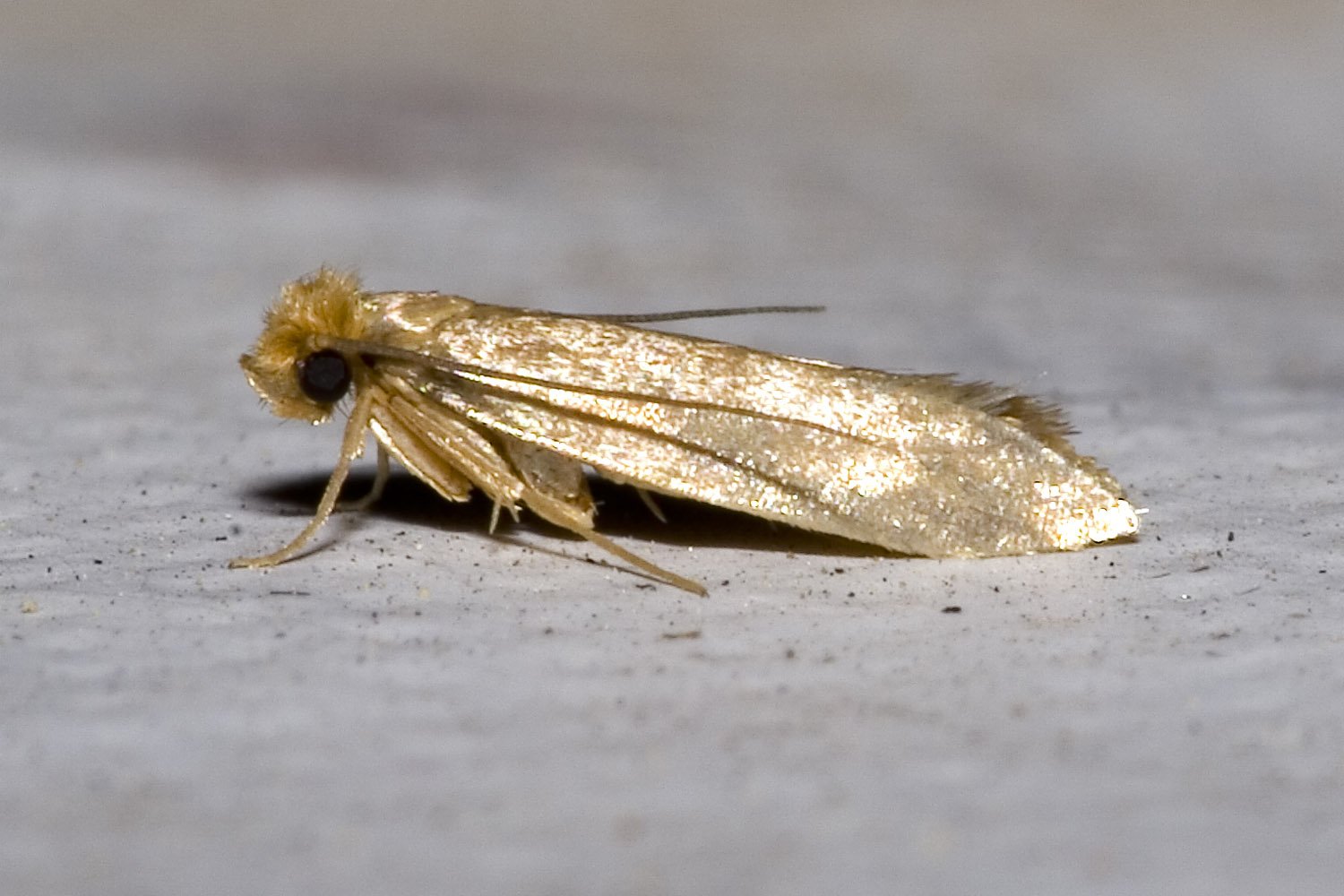
Clothes moths are smaller, plain buff or golden in color, and tend to stay in dark closets, drawers, and storage boxes rather than flying around open rooms, which is why infestations often go unnoticed until damage shows up. Their larvae feed on wool, silk, fur, and other animal fibers, including wool carpet and felt, and will also feed on synthetic blends if they’re soiled with food or sweat residue. Unlike pantry moths, clothes moth larvae actively avoid light, which is part of why damage tends to show up in folded or stored items rather than clothing that’s regularly worn and handled.
What to do
- Launder or dry clean affected items, since heat and cleaning kill both larvae and eggs
- Vacuum closets, carpet edges, and storage boxes thoroughly, then dispose of the vacuum bag outside
- Store off-season wool and silk items in sealed containers rather than open bins
- Cedar and lavender help deter moths from settling but won’t eliminate an active infestation on their own
- Check wool rugs, especially under furniture that rarely gets moved, since these are common overlooked sources
Telling them apart at a glance
Pantry moths cluster near the kitchen and stored food. Clothes moths stay closer to closets and rarely venture far from a fabric source. Wing pattern is another giveaway: pantry moths have a distinct two-toned wing, tan near the body and reddish-brown or coppery toward the tip, while clothes moths are a uniform, unmarked golden-buff color and tend to run or scurry rather than fly when disturbed.
Egg to adult: how fast each species develops
Pantry moth eggs hatch within four to ten days in a typical warm kitchen, and the larval stage that causes the actual damage runs roughly two to four weeks before the larva wanders off to pupate, often in a corner or crack well away from the food itself, which is why finding a stray cocoon on a wall or ceiling doesn’t always mean that spot is the source. Clothes moth eggs take slightly longer to hatch, four days to three weeks depending on temperature and humidity, and the larval stage is far more variable, anywhere from a month to well over a year in a cool, undisturbed closet, since a slow-feeding larva in a dark, low-activity space can take its time. In both species, the adult moths flying or scurrying into view are past the feeding stage entirely, they exist to mate and lay the next generation of eggs, not to eat, so seeing adults is a lagging indicator of a larval population that’s already been active for a while.
When it’s not actually a moth
A few other pantry and fabric pests get mistaken for moths regularly enough to be worth ruling out. Grain weevils, small, hard-shelled beetles that bore directly into whole grains and beans, don’t spin the webbing that pantry moth larvae leave behind, so a bag of rice with tiny holes bored into individual grains rather than a webbed clump points to weevils instead. In closets, carpet beetles cause fabric damage similar to clothes moths but their larvae are small, bristly, and oval rather than caterpillar-shaped, and they don’t leave silky webbing either, powdery or grainy debris is the more likely sign. Getting the identification right matters because the fixes barely overlap: a pheromone trap built for pantry moths won’t catch a weevil, and a treatment aimed at clothes moth larvae won’t touch a carpet beetle population feeding on the same wool rug.
Why these infestations are easy to miss at first
Both species prefer undisturbed, dark spaces, which is exactly why a pantry corner behind a rarely-used bag of flour or a garment bag at the back of a closet can host an infestation for weeks before anyone notices. Regular rotation of pantry stock, using older items before newer ones, and periodically checking stored clothing rather than leaving it sealed away for a full season both help catch a problem while it’s still small.
A few common questions
Can pantry moths spread to clothing, or clothes moths to food? No. Each species is adapted to a specific food source and won’t cross over, which is exactly why correctly identifying which one you have matters before you start treating. Will mothballs solve the problem? They can help deter moths in a sealed storage container, but they won’t do much for an active infestation already established in a cabinet or closet, and the odor lingers in fabric long after the moths are gone.
Do pantry moths or clothes moths bite people or pets? No, neither species bites or poses a direct health risk. The concern with pantry moths is contaminated food, and with clothes moths it’s damage to fabric, not any risk to people or animals in the house.
Is it worth setting pheromone traps even after a cleanout, just to monitor? Yes. A trap left in the pantry or closet for a few weeks after a cleanout is a low-effort way to confirm the source was actually found, a steadily declining or empty trap is a good sign, while a trap that keeps catching moths means something was missed.
How long an infestation takes to clear up
Pantry moths, once the infested food source is found and removed, typically clear up within a couple of weeks, since there’s no ongoing food supply for new larvae once the source is gone. Clothes moths can take longer, especially if the infestation has spread across multiple stored items or a rug that wasn’t checked closely, and it’s common to need a second, more thorough vacuuming pass two or three weeks after the first to catch any eggs that were missed the first time around.
DIY vs. calling a professional
Most pantry and clothes moth infestations are manageable without a pest management company, a thorough cleanout, proper storage, and consistent monitoring resolve the majority of cases within a few weeks. It’s worth bringing in a pest controller when the infestation keeps returning after two or more cleanouts, when damage is showing up in multiple rooms or storage areas at once, or when the source genuinely can’t be located, an infestation traced to a wall void, an inaccessible crawl space, or a stored item you can’t identify. A professional inspection can also make sense simply to save time on a larger property with multiple pantries or extensive stored textiles, where tracking down every possible source yourself could take far longer than having someone experienced do it in a single visit. Cost for a targeted moth treatment is generally modest compared to a lot of other pest issues, since it’s usually contained to a specific room or storage area rather than the whole structure, and most companies provide a free quote once they’ve had a look at what’s actually going on.
Prevention going forward
For pantry moths, buying dry goods in quantities you’ll use within a few months, rather than stockpiling, reduces the window an infestation has to establish itself. For clothes moths, rotating stored wool and silk items periodically, rather than leaving them sealed away untouched for a full year, gives you a chance to catch a problem early instead of discovering it when you finally pull out a sweater for the season.
If you’re finding damage but can’t pin down the source, or the problem keeps coming back after cleaning, that’s usually a sign of a hidden source, like an unopened bag of birdseed in a closet or an old rug in storage. One of our pest professionals can track it down and treat it properly. Call 1-844-783-4821.