Services
Fumigation
Whole-structure treatment for infestations that have moved into the wood itself — for the cases localized pest control can't fully reach.
Natural, guaranteed pest control — free quotes, no long-term contract, safe around kids and pets.
Signs You Need This
How to tell it's time to call
Fumigation usually comes up after other treatments haven't held, or when an inspection turns up activity in more than one part of the structure. Watch for small, six-sided pellets — drywood termite frass — collecting on windowsills, in attic corners, or under furniture, often pushed out through pinhole-sized kick-out holes in trim or framing. Discarded wings near windows and light fixtures after a swarm are another marker. For powderpost beetles, look for tiny round exit holes in exposed wood or flooring, with a fine, talc-like powder underneath them. Wood that sounds papery or hollow when tapped, or floors and stair treads that have started to sag, both point to damage that's gone on for a while. If those signs are showing up in more than one room, or in framing you can't easily get to, that's usually the point where a targeted treatment stops being enough.
The Full Picture
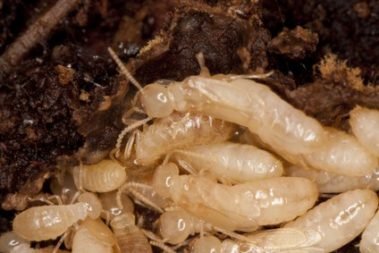
Fumigation is the one job on our list that isn't a spray-and-go visit — it's a full-structure treatment reserved for infestations that have spread through the wood itself rather than sitting in one accessible spot. Drywood termites and powderpost beetles both tunnel deep into framing, joists, and furniture in ways that surface treatments can't reach, which is why localized pest control often falls short here even after repeat visits.
We treat fumigation as a last-resort tool, not a default recommendation. Our fumigators walk the structure first to confirm the infestation is truly widespread before proposing it, because tenting a home is disruptive and we don't put a family through that unless it's what the wood actually needs. When it is, we handle every step — permits, neighbor notifications where required, tenting, monitored fumigant exposure, and clearance testing before anyone goes back inside. And the same guarantee applies here as everywhere else: if activity comes back, we come back, free of charge.
Our Approach
As your exterminator, fumigation isn't our first move — it's what we recommend once an inspection shows the infestation runs through structural wood we can't reach any other way. We'll always look at localized options first: spot treatment, heat, or targeted wood injection. When those won't reach every gallery hidden inside wall studs, rafters, or subflooring, whole-structure fumigation is the option that actually solves it. The process itself is straightforward: the structure gets tented and sealed, the fumigant circulates through every void and crawlspace at a controlled concentration, and we hold that exposure for the length of time needed to reach termites or beetles deep inside the wood — not just the ones near the surface. Once aeration clears the structure and we've confirmed safe re-entry, you're back in your home the same way you left it, minus the infestation. If live activity turns up afterward, we come back and make it right at no charge — no add-on fees, and no contract locking you into anything beyond this job.
Satisfaction Guaranteed
If it's not gone, we come back — free.
Safe & Humane
Natural methods, safe around kids and pets.
No Long-Term Contracts
Stay because it works — not because you're locked in.
The Details
Treatment Options & Products We Use
Treatment Options
Fumigation involves more homeowner prep than any other service we offer, since the entire structure is sealed and gas-treated at once.
- Pre-fumigation prep: all food, medications, and anything with an unsealed wrapper gets removed from the home or sealed in fumigant-rated nylon bags; pets, plants, and people are relocated for the duration; gas appliances and pilot lights are shut off ahead of time
- Neighbor and property notification: depending on local requirements, adjacent properties are notified before tenting begins, and warning signage goes up around the perimeter for the duration of the treatment
- Tenting: the structure is fully wrapped in gas-impermeable tarps, sealed at ground level, so the fumigant stays contained inside rather than dispersing
- Gas introduction and monitoring: the fumigant is released and its concentration is checked at multiple points throughout the structure on a set schedule, adjusting as needed to maintain a lethal dose in every void for the required exposure period
- Aeration and clearance: once exposure time is complete, tarps come down and the structure is ventilated, often with fans, until gas concentration readings fall below the safety threshold, and only then is re-entry cleared
Most residential fumigations run two to three days start to finish: a prep day, roughly 24 hours of tented exposure, and a half-day to full day of aeration before clearance testing confirms it's safe to move back in.
Products & Methods We Use
Structural fumigation relies on a narrow set of EPA-registered materials and monitoring equipment, all handled by licensed fumigators.
- Sulfuryl fluoride gas, the EPA-registered fumigant most commonly used for whole-structure treatment of drywood termites and powderpost beetles, chosen because it penetrates wood and wall voids without leaving a chemical residue behind
- Gas-impermeable tenting materials, heavy vinyl or canvas tarps rated to contain fumigant concentration, along with the clips, ropes, and sandbags used to seal them at ground level
- Gas concentration monitoring equipment used throughout exposure to confirm the fumigant stays at a lethal dose in every part of the structure, and again during aeration to confirm it's dropped to a safe level
- Aeration fans that speed up ventilation once the tarps come down, cutting the time between exposure and safe re-entry
What Customers Say
Real reviews from our Google Business Profile.
“Great company to deal with. They were courteous and they kept their appointment time to deal with my pest control problem. And they gave me a report of things I could do myself to help keep the pests away.”
Marlon Meginbir — Google review
View on Google →“Excellent advice and treatment of carpet beetles. Would recommend them.”
Kathleen Boulanger — Google review
View on Google →Questions
Frequently Asked About Fumigation
How much does fumigation cost?
Fumigation costs more than localized pest treatment because it's a whole-structure job — pricing depends on the size of the home, the extent of the infestation, and requirements like permits or neighbor notifications in your area. It's priced as a distinct project rather than a standard visit, and we only recommend it after confirming through inspection that the infestation is genuinely widespread enough to need it.
Is fumigation safe for my family and pets?
Fumigation requires everyone, including pets and plants, to be out of the structure for the length of the treatment and until clearance testing confirms it's safe to re-enter. We handle permits, notifications where required, and monitored exposure throughout, and nobody goes back inside until aeration and testing confirm the air is clear. It's the one service on our list that isn't natural-first by nature of what it treats, which is why it's a last resort, not a default recommendation.
Can drywood termites or powderpost beetles be treated without fumigation?
Sometimes, yes. Spot treatment, heat, or targeted wood injection can handle an infestation that's contained to one accessible area, and we always look at those options first. Fumigation becomes necessary when activity has spread through structural wood in multiple areas we can't reach any other way, like inside wall studs, rafters, or subflooring, where localized treatment can't reach every gallery.
How long does fumigation take, and how long do results last?
The full process, from tenting and sealing to fumigant exposure, aeration, and clearance testing, typically takes a few days from start to finish, most of which is the structure being tented rather than anyone actively working on it. Because fumigation reaches pests deep inside wood that surface treatments can't touch, results are thorough and long-lasting, and any post-treatment activity is covered under the same no-charge guarantee as every other service.
What signs mean I might need fumigation instead of a regular treatment?
Small six-sided pellets, drywood termite frass, collecting on windowsills, in attic corners, or under furniture, often pushed through pinhole-sized kick-out holes, are a strong indicator. Tiny round exit holes with fine, talc-like powder underneath point to powderpost beetles. If those signs show up in more than one room, or in framing that's hard to access, that's usually the point where an inspection is used to check whether fumigation is actually warranted.
What's the difference between fumigation and regular termite treatment?
Regular termite treatment targets a colony in a specific, accessible location using barrier or bait methods without needing to leave the home. Fumigation is reserved for infestations that have spread through the structural wood itself in ways surface treatment can't reach, and it requires tenting the entire structure and vacating it for the length of treatment. One is a spray-and-monitor process; the other is a full-structure event only recommended once inspection confirms it's necessary.
Learn More
Trusted resources on this topic
Guidance from health and regulatory bodies. In Canada, see Health Canada.
- EPA: Controlling Pests ↗U.S. guidance on choosing and using pest control safely.
- National Pesticide Information Center ↗Pest-by-pest fact sheets from Oregon State University and the EPA.
- Health Canada: Pesticides and Pest Management ↗Canadian guidance on pest control products.
Keep exploring
Related pest control services
Areas we serve
- Pest control in Kamloops
- Pest control in Kelowna
- Pest control in Langley
- Pest control in Lumberton
- Pest control in Merritt
- Pest control in Mesa
- Pest control in Naples
- Pest control in Nederland
- Pest control in North Scottsdale
- Pest control in Orangevale
- Pest control in Orillia
- Pest control in Paradise Valley
- Every location we serve
Ready to deal with it, for good?
Talk to a real expert — no pressure, no toxic chemicals, no contract required.
Recognized by the organizations that set the standard