Services
Ant Treatment
A trail of ants across your kitchen counter is a scouting report, not the whole problem. We find the colony behind it and treat that, using natural-first methods that hold up over time.
Natural, guaranteed pest control — free no-obligation quotes, no contract, safe around kids and pets.
Signs You Need This
How to tell it's time to call
The most common sign is a steady line of ants following the same path, day after day, usually along a baseboard, under a window sill, or across a countertop toward the sink or pet food bowl. Look closer at door frames, deck posts, or window trim for a fine pile of what looks like sawdust or wood shavings; that's carpenter ant frass, and it usually means active damage to the wood behind it, not just a nuisance trail. Small mounds of loose soil pushing up between pavers, in a garden bed, or at the edge of the lawn point to an outdoor colony that hasn't found its way indoors yet, but will once the weather turns. Ants that vanish for a few days after you wipe down a counter and then reappear in the exact same spot are a sign the colony is still there, just waiting out the disruption.
The Full Picture
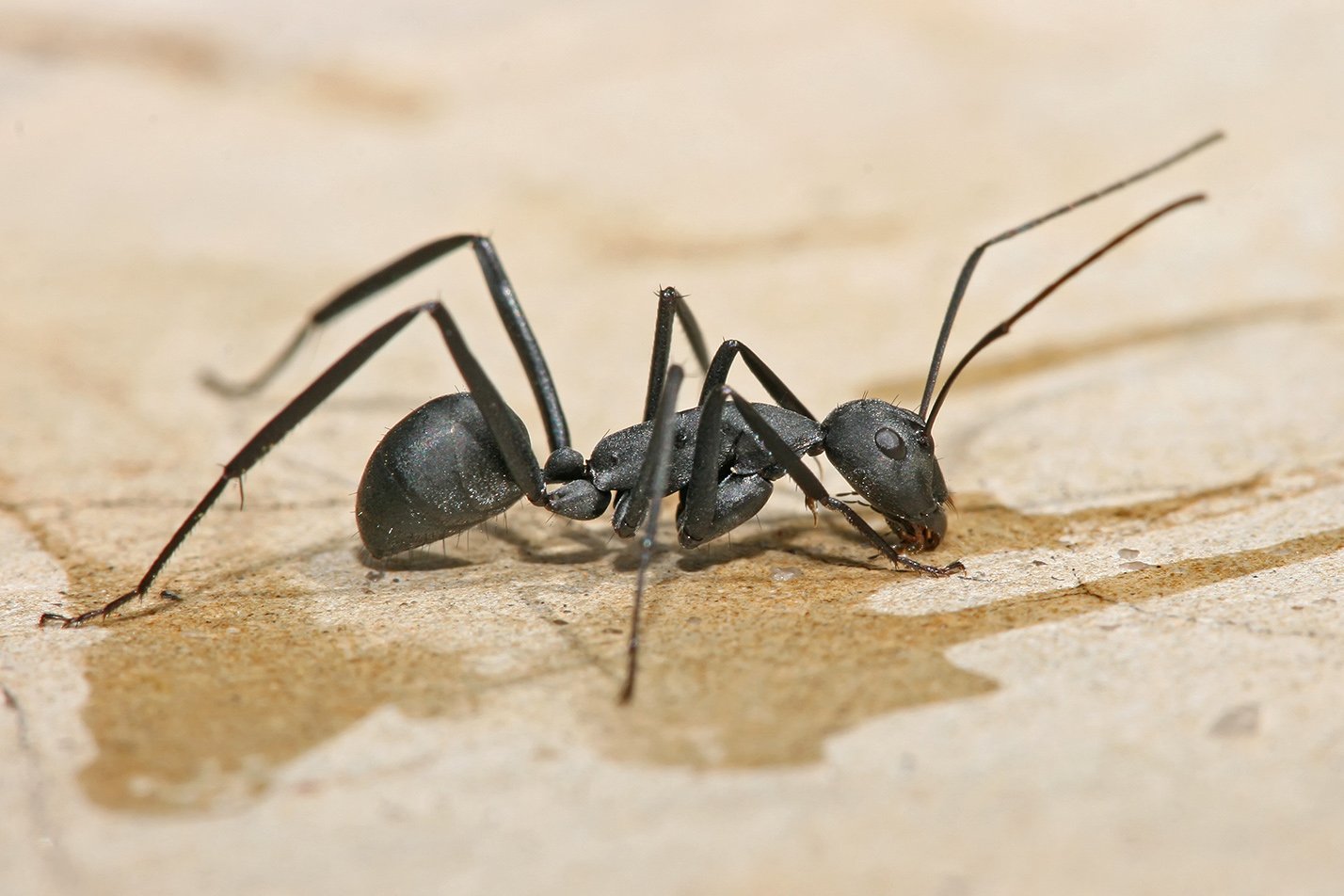
Ants that show up in your kitchen or bathroom aren't lost. A scout found a food or water source, laid down a pheromone trail back to the nest, and now the rest of the colony is following it. Spraying the visible line kills the ants you can see and does nothing to the thousands still in the nest, so the trail comes back in a day or two, sometimes in a new spot along the same wall. That's why we work backward from the trail to the colony itself, whether it's tucked into a foundation crack, a hollow porch post, or moisture-softened framing behind a shower wall.
The species matters as much as the location. Carpenter ants hollow out damp or rotting wood and leave behind coarse sawdust-like frass, which is a structural issue as much as a pest one. Odorous house ants and pavement ants are after food and water and will nest under slabs, in mulch beds, or inside wall voids near plumbing. Pharaoh ants split colonies when disturbed, which means the wrong treatment can multiply your problem instead of solving it. We treat for what's actually in your home, and if ants come back after we've been out, we come back too. No charge, no contract required to make that true.
Our Approach
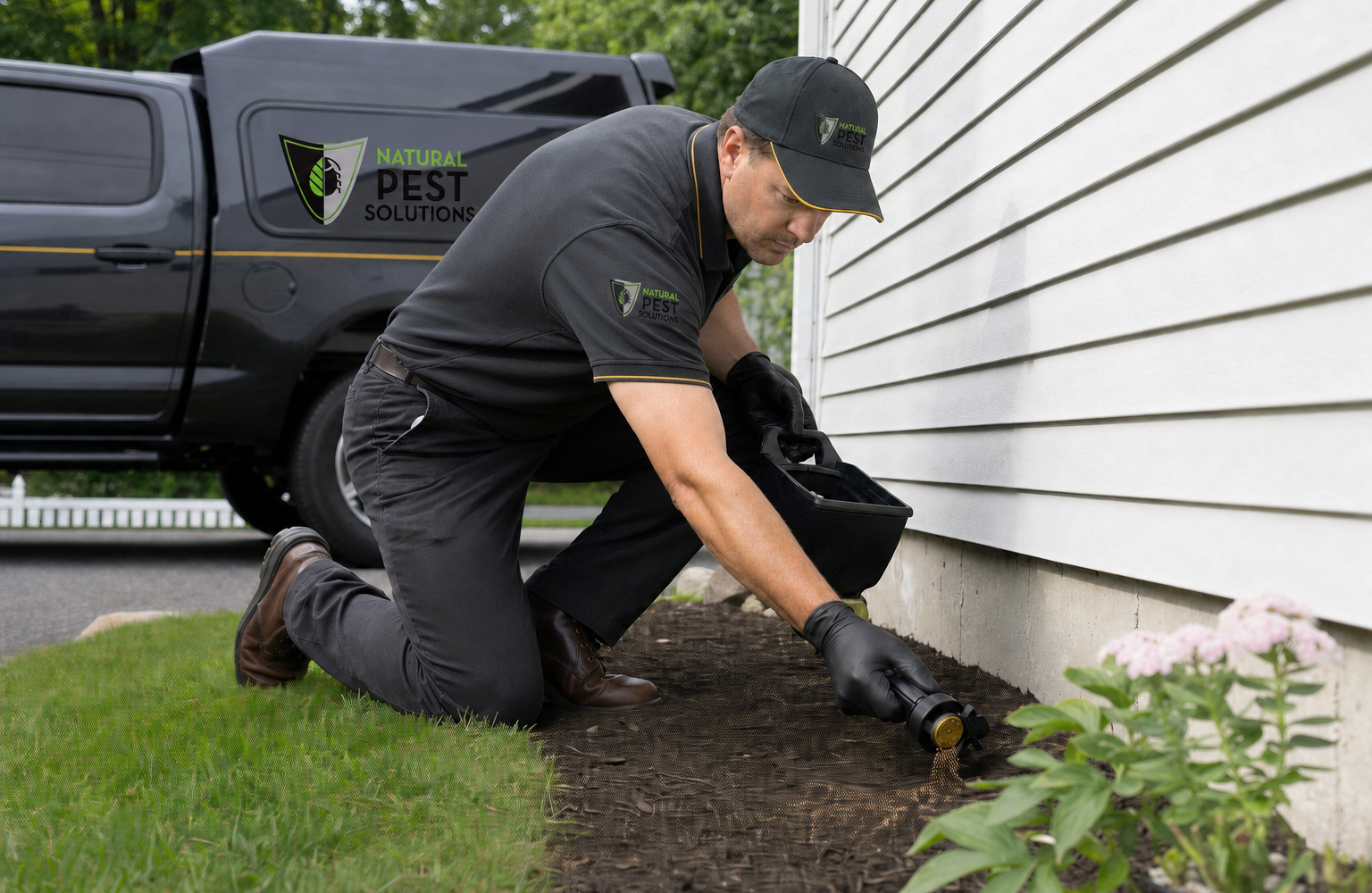
As your pest control contractor, we start by identifying the species, because a carpenter ant colony in a damp wall stud calls for a different approach than pavement ants nesting under a walkway or odorous house ants working a kitchen sink. Rather than blanket-spraying indoor surfaces, we place species-matched bait where ants are actually foraging so workers carry it back and share it through the colony, and we treat the exterior perimeter and known entry points with plant-derived active ingredients that keep working without leaving a chemical residue across the rooms you live in. For carpenter ants, we also check the extent of any wood damage so you know what you're dealing with structurally, not just what's crawling on the counter. If activity returns after treatment, we come back and address it at no additional cost, and you're never locked into a contract to get that follow-through. Not sure if it's ants or something else living in the wall? A quick inspection tells you which before we treat anything.
Satisfaction Guaranteed
If it's not gone, we come back — free.
Safe & Humane
Natural methods, safe around kids and pets.
No Contracts
Stay because it works — not because you're locked in.
The Details
Treatment Options & Products We Use
Treatment Options
Every ant job starts with tracing activity back to its source rather than treating what's visible. A technician follows the foraging line to its entry point, checks likely void spaces (wall cavities, slab expansion joints, under-sink cabinets) with a flashlight and probe, and for suspected carpenter ant activity, taps suspect framing and checks moisture readings to gauge how far damage extends before any product goes down.
- Crack-and-crevice application: bait and residual product are injected directly into cracks, weep holes, and expansion joints rather than sprayed across open surfaces.
- Void treatment: wall voids and hollow posts get a light dust or foam application so ants moving through the space pick up product on contact.
- Granular perimeter barrier: a treated band around the foundation intercepts colonies before they reach an entry point, refreshed on a seasonal schedule.
- Exclusion: gaps around utility penetrations, weep holes, and expansion joints get sealed once activity clears, so a new colony can't just move into the same entry point.
Most single-species trail issues resolve in one to two visits, spaced roughly two weeks apart to give bait time to reach the full colony. Multi-colony properties, or homes with both an indoor kitchen trail and a separate exterior mound, get a broader first visit and a scheduled follow-up rather than a one-and-done treatment, since knocking down one colony while a second is still established nearby is how ants seem to come back days later.
Products & Methods We Use
- Non-repellent, slow-acting gel and granular baits formulated for the target species, so workers carry product back to the colony instead of being repelled from it
- Insect growth regulators (IGRs) that disrupt colony reproduction over time, used alongside baiting for longer-term suppression
- Botanical/pyrethrin-based contact sprays for spot treatment of crack-and-crevice entry points, used sparingly rather than as a broadcast application
- Boron-based dust for void and wall-cavity treatment where ants travel but a liquid or gel isn't practical
- Weatherproof sealants and foam for closing entry points once activity clears
- Moisture meters and visual inspection tools to assess wood condition where carpenter ants are suspected
Products are matched to the species identified during inspection; a carpenter ant job in damp framing calls for different placement and formulation than a pavement ant colony working a slab joint.
What Customers Say
Real reviews from our Google Business Profile.
“I am very happy with the service I received from Natural Pest Solutions, they took my call right away and came right out and inspected my home and found the source of my ant problem and since they were here I have not seen a single bug around. I would recommend these guys to anyone needing pest control services.”
Rick Gruenke — Google review
View on Google →“I am very happy with the results that Natural Pest Solutions was able to provide as far as the speed of their work and also the problem with ants in my home was able to be resolved quickly which gave me peace of mind. I would recommend this pest control company to anyone having issues with bugs.”
Stefano Merci — Google review
View on Google →Questions
Frequently Asked About Ant Treatment
How much does professional ant treatment cost?
Cost depends on the ant species, how large the colony is, and how many entry points need treating — a small kitchen trail is a lot cheaper to handle than a carpenter ant colony spread through a wall stud. Most single-visit ant treatments run in the low-to-mid hundreds of dollars, with carpenter ant jobs trending higher because of the extra time spent tracing wood damage. Ongoing plans with quarterly perimeter treatment often cost less per visit than a one-time emergency call.
Is ant treatment safe for kids and pets?
Yes — we lead with plant-derived baits and natural-first products specifically because they don't require clearing the house for hours or keeping pets off the floor. Baits are placed in cracks, voids, and other spots pets and kids don't reach, rather than sprayed across countertops or floors. The goal is treating where ants forage, not blanketing living space in chemicals.
Can I get rid of ants myself, or do I need to hire an exterminator?
Store-bought sprays kill the ants you see but leave the colony, often thousands deep, untouched, so the trail typically comes back within a day or two, sometimes in a new spot. DIY bait stations can work for small odorous house ant trails if you're patient and don't disturb them. Carpenter ants are different: because they nest in damp or compromised wood, spraying and scattering a colony usually makes the problem worse and harder to find later.
How long does it take to get rid of ants, and how long do results last?
Bait-based treatment usually takes one to two weeks to fully knock down a colony, since worker ants need time to carry bait back and share it with the nest — slower than a spray, but it actually reaches the queen. Once the colony is eliminated and entry points are sealed, results typically hold for months, though outdoor colonies near the foundation can attempt to move back in seasonally. If ants return, we come back at no charge.
How can I tell if I have an ant infestation and not just a few strays?
A few ants wandering alone are scouts; a steady line following the same path day after day, along a baseboard or across a counter toward food or water, means the colony has committed to that route. Piles of fine sawdust-like material near door frames, deck posts, or window trim point to carpenter ants actively damaging wood, not just foraging. Ants that vanish for a few days after cleaning and then reappear in the exact same spot mean the nest is still there.
What's the difference between carpenter ants and odorous house ants?
Carpenter ants are larger, often black or reddish-black, and don't eat wood the way termites do — they hollow it out to nest in it, targeting damp or already-softened framing, which makes them a structural concern. Odorous house ants are smaller and nest in mulch, under slabs, or in wall voids near plumbing, drawn purely by food and water. Because carpenter ants signal a moisture or damage problem, they usually call for a closer look at the wood, not just baiting the trail.
Learn More
Trusted resources on this topic
Guidance from health and regulatory bodies. In Canada, see Health Canada.
- National Pesticide Information Center ↗Pest-by-pest fact sheets from Oregon State University and the EPA.
- EPA: Controlling Pests ↗U.S. guidance on choosing and using pest control safely.
- Health Canada: Pesticides and Pest Management ↗Canadian guidance on pest control products.
Keep exploring
Related pest control services
Areas we serve
- Pest control in West Kelowna
- Pest control in Abbotsford
- Pest control in Apache Junction
- Pest control in Archway
- Pest control in Armstrong
- Pest control in Barrie
- Pest control in Beaumont
- Pest control in Berwick
- Pest control in Brisbane
- Pest control in Calgary
- Pest control in Chandler
- Pest control in Chilliwack
- Every location we serve
Ready to deal with it, for good?
Talk to a real expert — no pressure, no toxic chemicals, no contract required.
Recognized by the organizations that set the standard