
Ants are among the most common household pests in the US, Canada, Australia, and the UK, and for most homeowners they show up as a trail of tiny foragers crossing a kitchen counter or patio. While a few ants rarely cause harm, an established colony is a different story: some species build nests directly inside wall voids, wood framing, or insulation, while others contaminate stored food or deliver a painful sting. What makes ants tricky to manage is that the ants you see are only a small fraction of the colony — the queen and the bulk of the workers stay hidden in a nest that can be located metres away from where you’re finding them. Spraying the ants you can see does little more than scatter the colony and can actually make an infestation harder to track down. Getting ahead of an ant problem means correctly identifying the species (carpenter ants, odorous house ants, pavement ants, and fire ants all behave differently and require different strategies), finding the nest or nests, and cutting off the food and moisture sources drawing them indoors. Because ant colonies can number in the thousands and split into multiple satellite nests, a targeted, patient approach outperforms a quick spray every time.
What It Looks Like
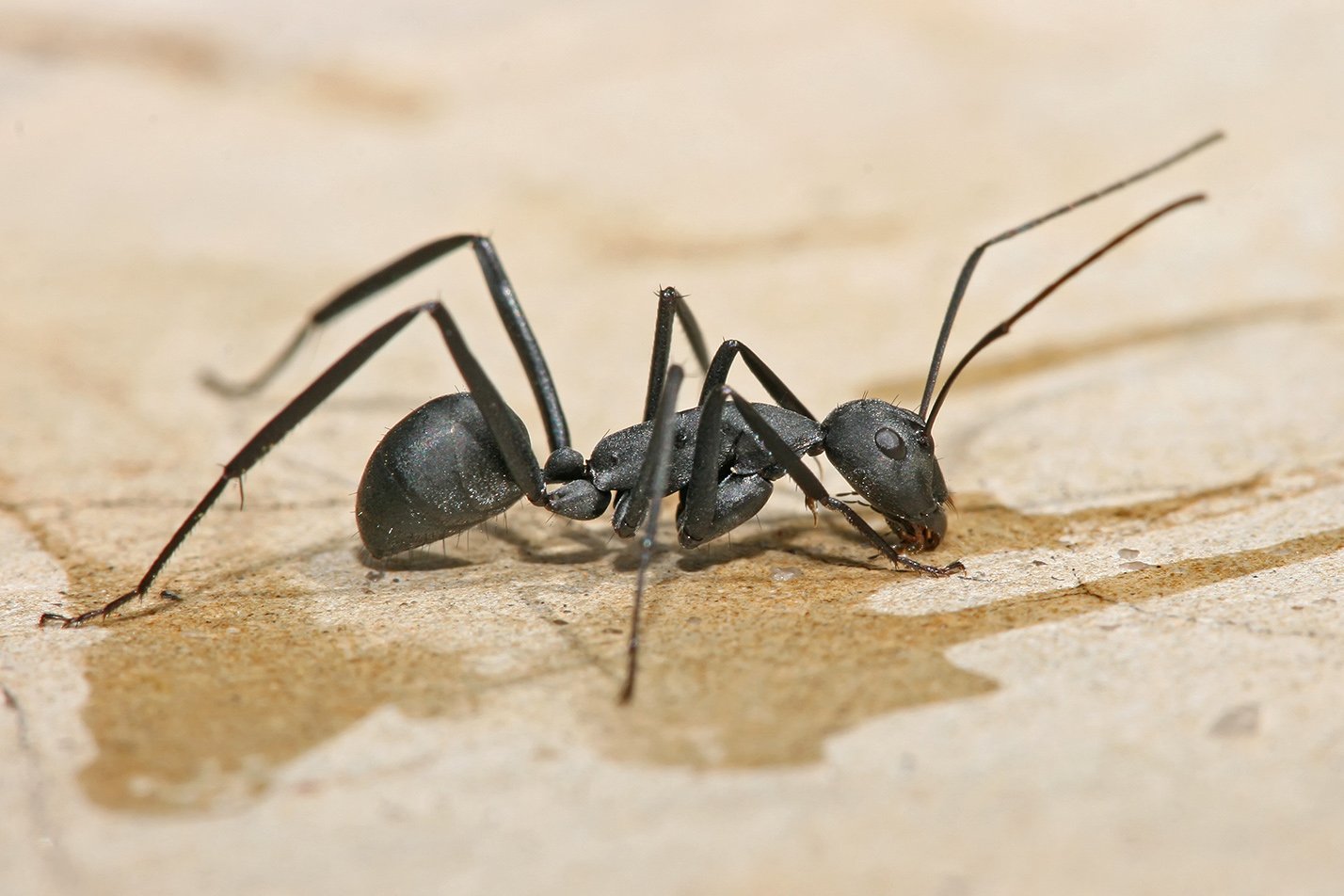
Household ants are small insects, typically ranging from 2 to 13 mm long depending on species, with a narrow, pinched "waist" (petiole) connecting the thorax and abdomen, elbowed antennae, and six legs. Coloring ranges from black and brown to reddish-brown; carpenter ants are among the largest common household species, while odorous house ants and pharaoh ants are much smaller and often pale to dark brown.
Winged reproductive ants (swarmers) can be mistaken for termites, but ants have a pinched waist, bent antennae, and two pairs of unequal-length wings, while termites have a straight waist, straight antennae, and equal-length wings.
Where It’s Commonly Found
Ants nest both outdoors and indoors. Outdoor colonies are commonly found in soil, under mulch beds, beneath pavement or landscape timbers, and inside tree stumps or woodpiles. Indoors, many species are drawn to moisture-damaged wood, wall voids, and insulation, especially near sinks, water heaters, and leaky pipes.
Carpenter ants prefer damp or decaying wood for nesting and excavating galleries, while species such as odorous house ants and pharaoh ants will nest almost anywhere they find warmth and reliable access to food, including inside wall cavities and beneath flooring.
Signs of an Infestation
- Visible foraging trails along counters, baseboards, or exterior walls
- Discarded wings near windowsills or doors after a swarming event
- Small piles of soil, sand, or wood shavings near entry points or baseboards
- Rustling or faint clicking sounds inside wall voids (often carpenter ants)
- Sawdust-like frass pushed out of small holes in wood (carpenter ants)
- Ants consistently appearing near a specific food or moisture source
Health & Property Risks
Most household ants are primarily a nuisance and food-contamination concern rather than a direct health threat, since foraging ants can transfer bacteria to countertops, food packaging, and stored food. Some species, such as fire ants, can deliver painful stings, and a small number of people experience allergic reactions to bites or stings.
Carpenter ants present more of a property risk than a health risk. They don't eat wood the way termites do, but they excavate smooth galleries in damp or previously damaged wood to build nests, which can weaken structural or decorative wood members over time if an infestation goes unaddressed.
Treatment Options
- On-site inspection to identify the ant species, locate foraging trails, and pinpoint nest locations or satellite colonies
- Exterior perimeter treatment to create a barrier at common entry points and along the foundation
- Interior crack-and-crevice treatment targeting baseboards, cabinetry, and plumbing penetrations
- Gel baiting, which allows foraging workers to carry a slow-acting active ingredient back to the nest and queen for colony-level control
- Granular bait application for outdoor colonies and mound sites
- Moisture correction and identification of damaged or decayed wood, particularly important for carpenter ant activity
- Exclusion work to seal visible entry points around utility lines, windows, and foundation cracks
- Follow-up monitoring to confirm the colony has been eliminated and catch any re-infestation early
Products & Methods We Use
- Slow-acting gel baits formulated to be carried back to the nest by foraging workers
- Granular outdoor baits for perimeter and landscape application
- Non-repellent residual insecticides for crack-and-crevice and perimeter treatment
- Insect growth regulators (IGRs) included in some bait and residual formulations to disrupt colony development
- Diatomaceous earth applied in dry, protected areas such as wall voids
- Boric-acid-based bait formulations for targeted indoor use
Prevention Tips
- Seal cracks and gaps in the foundation, siding, and around utility penetrations
- Fix plumbing leaks and reduce excess moisture around sinks, water heaters, and crawlspaces
- Store food, including pet food, in sealed containers
- Wipe up crumbs and spills promptly, especially in kitchens
- Trim tree branches and shrubs so they don't touch the house, and keep mulch pulled back from the foundation
- Store firewood and lumber off the ground and away from the home's exterior