Services
Rodent Control
Mice and rat control that finds the entry points, not just the symptoms — trapping and exclusion that actually keeps rodents out, guaranteed.
Natural, guaranteed pest control — free quotes, no long-term contract, safe around kids and pets.
Signs You Need This
How to tell it's time to call
Droppings near baseboards, cabinets, or pantry shelves. Gnaw marks on food packaging, wood, or wiring. Scratching sounds in walls or ceilings at night. A stale, musky odor in enclosed spaces like closets or under sinks. Rodents leave a trail — literally — before you ever see one.

The Full Picture
Mice and rats aren't just a nuisance. They contaminate food, chew through wiring (a real fire risk), and multiply fast — a single pair can lead to dozens of rodents within months. We start by finding and sealing entry points, not just setting traps and hoping. Exclusion is what actually stops the problem from coming back.
As your exterminator, our approach combines targeted trapping and exclusion work with an inspection thorough enough to catch the entry points you'd never spot yourself — under eaves, around utility lines, gaps as small as a quarter-inch.
Our Approach
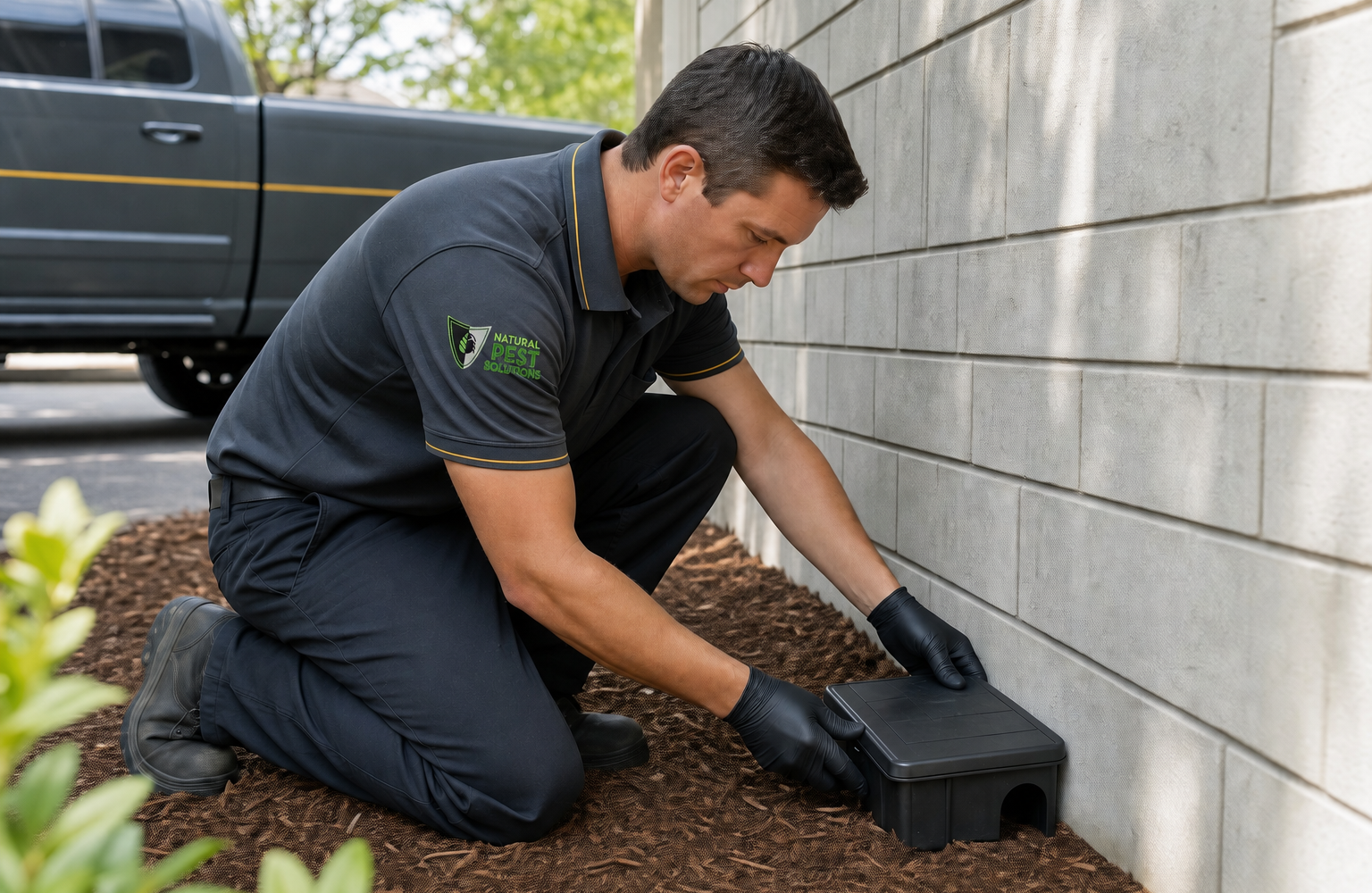
No poison bait scattered where kids or pets can reach it. As pest professionals, we use trapping and physical exclusion first, and reserve rodenticide for tamper-resistant, professionally placed stations only when needed.
Satisfaction Guaranteed
If it's not gone, we come back — free.
Safe & Humane
Natural methods, safe around kids and pets.
No Long-Term Contracts
Stay because it works — not because you're locked in.
The Details
Treatment Options & Products We Use
Treatment Options
Rodent control combines several trapping and exclusion methods depending on the severity and location of the infestation. A pest control professional working a rodent job typically uses:
- Snap traps placed along walls and travel paths identified by droppings, rub marks, and gnaw damage, since rodents run along edges rather than open floor space, making trap placement as important as the trap itself.
- Tamper-resistant bait stations, used selectively and only in areas inaccessible to kids and pets, such as attics, crawlspaces, or exterior perimeters, for infestations too large for trapping alone to resolve in a reasonable timeframe.
- Exclusion work sealing gaps as small as a quarter-inch for mice and a half-inch for rats, using steel wool, hardware cloth, and copper mesh in combination with caulk or foam, since rodents can chew through plain foam or plastic on their own.
- Attic and crawlspace inspection for nesting material, insulation damage, and chewed wiring, which is often where the real fire and structural risk shows up even when the visible signs are limited to a kitchen or pantry.
- Door sweeps and vent screens on gable and foundation vents, common entry points that get missed when treatment focuses only on obvious gaps at ground level.
Follow-up visits confirm trap activity has stopped and no new entry points have opened up before the job is considered done.
Products & Methods We Use
Products and equipment used for rodent control include:
- Snap traps for active infestations and ongoing monitoring
- Tamper-resistant, professionally placed bait stations for larger infestations, kept out of reach of kids and pets
- Steel wool, copper mesh, and hardware cloth for sealing entry points rodents can't chew through
- Caulk and expanding foam sealant for smaller gaps and cracks
- Door sweeps and vent screens for exterior entry points
- Glue boards for monitoring activity in areas where trap placement needs confirmation
We prioritize trapping and physical exclusion as non-toxic, kid- and pet-safe first steps, reserving rodenticide for tamper-resistant stations only when the size of the infestation genuinely calls for it.
What Customers Say
Real reviews from our Google Business Profile.
“I am really pleased with the guys at Natural Pest Solutions, they got rid of my rodent problem quickly and those mice have not been back. I highly recommend these guys, they are the best pest control company around.”
Shawn Kern — Google review
View on Google →“I really am impressed with the great customer service and how quickly they came to help me with my rodent problem. After doing a pest inspection they found that the problem was much worse than I expected, but the guys at Natural Pest Solutions came to my rescue and got rid of all these nasty pests in my home.”
Phillip Pond — Google review
View on Google →“Natural Pest Solutions just finished a job at my house. They explained everything in detail and answered every question. On time, professional, and neatly attired. Highly recommended!”
William Morgan — Google review
View on Google →Questions
Frequently Asked About Rodent Control
How much does rodent control cost?
Cost depends on how many entry points need sealing and whether it's a light mouse problem or an established rat infestation needing ongoing trapping. Most single-visit trapping and sealing jobs land in the low-to-mid hundreds, with larger properties or heavier infestations running higher since exclusion work — not just bait — is the real cost driver.
Is rodent control safe for kids and pets?
Yes — we lead with trapping and physical exclusion rather than scattering poison bait, and any rodenticide we do use goes into tamper-resistant, professionally placed stations only when needed. That's specifically to keep it safe around kids and pets, since loose bait is one of the more common ways pets get sick from pest control.
Can I get rid of mice myself with traps from the store?
Store-bought traps can catch individual mice, but if you're not finding and sealing the entry points — gaps as small as a quarter-inch around utility lines and eaves — you'll keep catching mice indefinitely because more keep coming in behind them. Professional control treats the opening, not just the symptom.
How long does it take to get rid of mice or rats, and will they come back?
Trapping typically clears active activity within one to two weeks depending on the size of the population, but the exclusion work — sealing entry points — is what determines whether they come back. Skip that step and you're likely to see new activity within a season, since a single pair can lead to dozens of rodents within months.
What are the first signs of a rodent problem?
Droppings near baseboards, cabinets, or pantry shelves are usually the first thing people notice, along with gnaw marks on food packaging, wood, or wiring and scratching sounds in the walls or ceiling at night. A stale, musky smell in an enclosed space like a closet or under a sink is also a reliable sign, even before you've spotted a rodent directly.
What's the difference between mouse control and rat control?
The core approach — find entry points, exclude, trap — is the same, but rats are stronger, more cautious around new objects like traps, and typically need heavier-duty exclusion materials since they can chew through material a mouse can't. Rats also tend to nest lower, near foundations and in outdoor burrows, while mice are just as likely to nest in wall voids or attics.
Learn More
Trusted resources on this topic
Guidance from health and regulatory bodies. In Canada, see Health Canada.
- CDC: Rodents ↗Health risks from rodents and how to prevent them.
- EPA: Controlling Pests ↗U.S. guidance on choosing and using pest control safely.
- Health Canada: Pesticides and Pest Management ↗Canadian guidance on pest control products.
Keep exploring
Related pest control services
Areas we serve
- Pest control in DC Ranch
- Pest control in Edmonton
- Pest control in Fountain Hills
- Pest control in Gainesville
- Pest control in Gainey Ranch
- Pest control in Gilbert
- Pest control in Kamloops
- Pest control in Kelowna
- Pest control in Langley
- Pest control in Lumberton
- Pest control in Merritt
- Pest control in Mesa
- Every location we serve
Ready to deal with it, for good?
Talk to a real expert — no pressure, no toxic chemicals, no contract required.
Recognized by the organizations that set the standard