
Termites cause more structural damage to homes in the US each year than fire, wind, and flood damage combined, and unlike most pests, an infestation can go unnoticed for months or years before it’s discovered — often when a homeowner presses a finger into what looks like solid trim and it crumbles. Termites feed on the cellulose in wood, paper, and other plant material, and a mature colony can contain hundreds of thousands of workers steadily consuming structural lumber, flooring, and framing around the clock. There are two termite types relevant to most properties: subterranean termites, which live in the soil and build mud tubes to travel between the ground and the wood they’re feeding on, and drywood termites, which live entirely inside the wood itself with no soil contact required. Because termite damage is rarely covered by standard homeowners insurance, prevention and early detection matter far more than with most household pests. A proper termite program isn’t a one-time spray — it typically combines a soil or bait-based barrier around the structure with ongoing monitoring, since termite activity is largely invisible until damage is already underway.
What It Looks Like
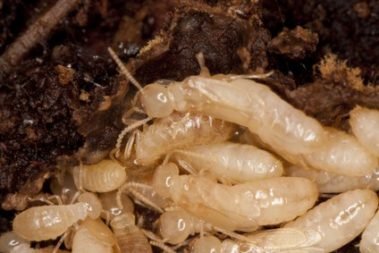
Termites are small, soft-bodied insects, generally 1/8 to 1/2 inch long, often mistaken for ants. Worker termites are creamy-white to grayish and blind, while soldier termites have larger, darker heads with pincer-like mandibles used to defend the colony. Winged reproductive termites (alates) are dark brown to black with two pairs of wings of equal length.
Termites can be told apart from flying ants by their straight, beadlike antennae, thick waist, and equal-length wings, compared to an ant's bent antennae, pinched waist, and unequal wings.
Where It’s Commonly Found
Subterranean termites live in colonies based in the soil and require contact with ground moisture to survive, building visible mud tubes to travel from soil to wood sources above ground. They commonly enter homes through foundation cracks, expansion joints, and areas where wood contacts soil.
Drywood termites, by contrast, nest directly inside dry wood and don't need soil contact, making them common in attic framing, wall studs, furniture, and other above-ground wood. Both types thrive in warm, humid climates but are found throughout much of the United States.
Signs of an Infestation
- Mud tubes running along foundation walls, piers, or crawlspace supports
- Wood that sounds hollow or papery when tapped
- Discarded wings scattered near windowsills or doors following a swarm
- Small fecal pellets (frass) resembling coffee grounds or sawdust, a hallmark of drywood termites
- Blistering, sagging, or bubbling paint and wood surfaces
- Swarms of winged termites appearing indoors, often in spring
Health & Property Risks
Termites are primarily a property and structural risk rather than a direct health risk. Colonies feed continuously on cellulose in wood, flooring, and structural framing, and left unaddressed over months or years, this feeding can compromise the structural integrity of a home and lead to costly repairs.
Termites are not known to spread disease to humans or pets. In some cases, long-term moisture issues associated with an infestation can contribute to secondary concerns like mold growth, but the termites themselves are a structural pest rather than a medical one.
Treatment Options
- Thorough inspection of the foundation, crawlspace, attic, and areas of wood-to-soil contact to determine species and extent of activity
- Liquid soil treatment applied around and beneath the structure to create a continuous treated zone that subterranean termites cannot cross undetected
- Installation of in-ground termite bait stations around the perimeter, monitored on a regular schedule
- Localized or spot treatment of drywood termite galleries when infestation is limited
- Whole-structure fumigation for widespread drywood termite infestations that can't be reached with spot treatment
- Borate wood treatments applied during construction, renovation, or as a preventive measure on exposed framing
- Ongoing monitoring and annual inspection agreements to catch new activity early
Products & Methods We Use
- EPA-registered non-repellent liquid termiticides for soil treatment around the foundation
- In-ground bait stations containing slow-acting active ingredients that disrupt termite development and are shared throughout the colony
- Borate-based wood treatments applied directly to exposed framing and structural wood
- Structural fumigants used for whole-building treatment of extensive drywood termite infestations
- Foam termiticide formulations for treating localized voids and hard-to-reach galleries
Prevention Tips
- Reduce direct wood-to-soil contact around the foundation, including deck posts and stair stringers
- Correct drainage issues so water flows away from the foundation rather than pooling against it
- Store firewood and lumber off the ground and well away from the structure
- Keep mulch pulled back a few inches from the foundation and avoid piling it too deep
- Repair leaky faucets, gutters, and air conditioning condensation lines promptly
- Schedule regular professional termite inspections, particularly in older homes or high-risk climates