
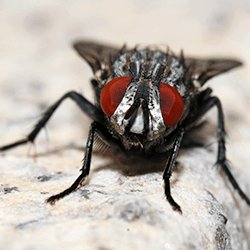
The house fly (Musca domestica) is the species most homeowners and businesses mean when they say “flies” — a fast-breeding, highly mobile insect found virtually everywhere humans live, across the US, Canada, Australia, and the UK. House flies are drawn to decaying organic matter — garbage, pet waste, compost, spoiled food — where they feed and lay eggs, and a female can lay several hundred eggs in her short lifespan, which is typically just a few weeks but can produce several overlapping generations in a single season.
Flies matter beyond the annoyance factor because of how they feed and move. A house fly can’t chew solid food — it vomits digestive enzymes onto a surface to liquefy it, then sponges it up, repeating this on every surface it lands on. Because flies move freely between garbage, drains, animal waste, and food prep surfaces, they’re recognized as one of the more significant mechanical carriers of bacteria in and around homes and food businesses, which is why fly pressure in a kitchen or dining area is taken seriously rather than dismissed as cosmetic.
What It Looks Like
The common house fly is about 6 mm long with a dull gray thorax marked by four dark longitudinal stripes and a single pair of clear wings. Blow flies are slightly larger with a metallic blue or green sheen, while fruit flies are much smaller, around 3 mm, with tan bodies and distinctive red eyes.
- Compound eyes covering most of the head
- Sponging mouthparts adapted for liquid feeding
- Single pair of functional wings, a defining trait of true flies
Where It’s Commonly Found
Flies are drawn to decaying organic matter, moisture, and food waste, making kitchens, garbage areas, and drains common indoor sites. Outdoors, house flies and blow flies breed in animal waste, garbage, compost, and carrion, while fruit flies breed in overripe produce, drains, and fermenting liquids. Warm, humid conditions accelerate their short breeding cycle, allowing populations to build quickly in and around a property.
Signs of an Infestation
- Clusters of flies around trash cans, compost bins, or pet waste areas
- Small, dark specks, known as fly spots, on windowsills, light fixtures, and walls
- Fruit flies persistently hovering near drains, ripening produce, or recycling bins
- Maggots, or fly larvae, found in garbage, drains, or decaying organic material
- Unusual fly activity concentrated in one room, which can indicate a hidden breeding source such as a dead rodent or leaking drain
Health & Property Risks
Flies are mechanical vectors of disease, meaning they pick up bacteria and pathogens from decaying matter, sewage, or animal waste on their legs and mouthparts and can transfer them to food preparation surfaces and stored food. This makes fly control a genuine food-safety concern in kitchens and dining areas, not just a nuisance issue. Large breeding populations can also indicate an underlying sanitation problem, such as a hidden carcass, clogged drain, or improperly managed waste, that should be identified and corrected alongside treatment.
Treatment Options
- Source identification and sanitation: a pest management company traces fly activity back to its breeding source, whether a drain, dumpster, compost area, or hidden organic material, since eliminating the breeding site is the most effective long-term control
- Drain treatment: gel or foam biological treatments are applied to drain lines to break down the organic film where fruit flies and drain flies breed
- Residual perimeter spraying: exterior surfaces around entry points, dumpsters, and eaves are treated with a residual insecticide to reduce fly landing and resting populations
- Baiting: fly baits formulated to attract and eliminate adult flies are placed in outdoor areas away from food-handling zones
- Mechanical and light-trap control: insect light traps and sticky traps are used indoors, particularly in commercial kitchens and food-storage areas, to reduce adult populations without chemical exposure near food
- Exclusion: door sweeps, air curtains, and screened windows are recommended to reduce the number of flies entering from outside
Products & Methods We Use
- EPA-registered residual perimeter sprays for exterior surfaces and entry points
- Biological and enzymatic drain gel treatments for organic buildup in drain lines
- Outdoor fly baits and bait stations
- Insect light traps (ILTs) and non-chemical sticky trap monitors
- Insect growth regulators (IGRs) to disrupt larval development in breeding areas
Prevention Tips
- Keep garbage cans and compost bins tightly sealed and cleaned regularly
- Clean up pet waste from yards promptly
- Repair or replace damaged window and door screens
- Rinse recycling containers to remove food and beverage residue
- Address slow or standing drains, which can become fruit fly and drain fly breeding sites
- Store ripening produce in the refrigerator or covered containers rather than left out on counters