
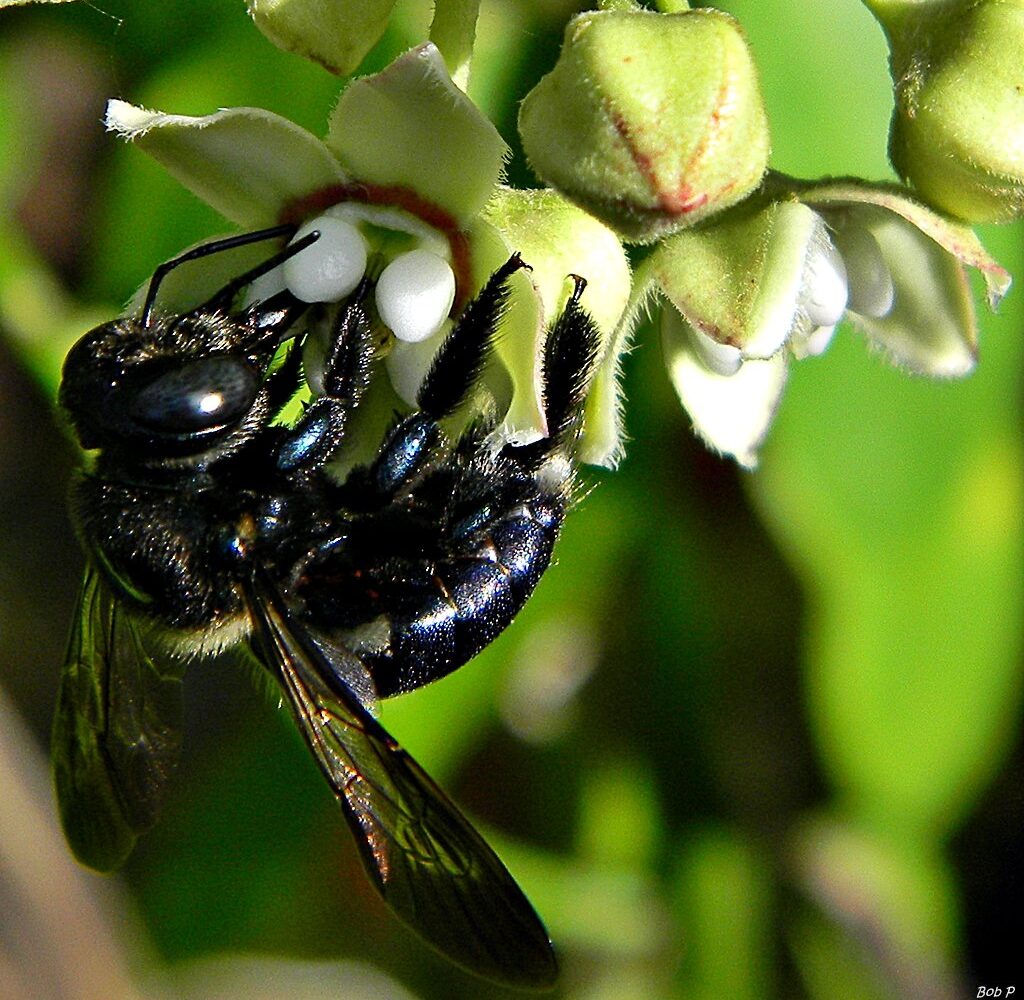
What It Looks Like
Carpenter bees are large, robust bees, often confused with bumblebees, typically 19 to 25 mm long with a shiny, mostly hairless black abdomen, whereas bumblebees have a fuzzy, fully hair-covered abdomen. Their thorax is covered in yellow or pale hair, and males often have a light-colored or white patch on the face, a helpful way to tell them apart from females, which lack the patch and are the only sex capable of stinging.
Where It’s Commonly Found
Carpenter bees are drawn to bare, unpainted, or weathered softwoods such as cedar, pine, redwood, and fir, and they commonly target deck boards, fascia, eaves, siding, fence posts, and outdoor furniture. Unlike social bees, carpenter bees are solitary and don't form hives; each female bores her own tunnel, though the same piece of wood can attract multiple bees and be reused and expanded year after year.
Signs of an Infestation
- Perfectly round, smooth entry holes about 13 mm across, usually on the underside of eaves, railings, or deck boards
- Coarse sawdust (frass) accumulating just below a hole
- Yellowish staining on wood surfaces beneath active tunnels
- Large bees hovering persistently around the same section of wood, especially in spring
- Male bees hovering or darting near people or pets close to the nest, a bluff display since males can't sting
- Tapping or faint rustling sounds from inside the wood near an active tunnel
Health & Property Risks
Carpenter bees are generally not aggressive: males will hover and dart at people or pets who get close to the nest, but they can't sting, and females rarely sting unless directly handled or trapped. The primary risk is structural rather than personal. Individual tunnels are usually just a few centimetres deep, but the same gallery reused and extended over multiple seasons, especially when several bees nest in the same board, can weaken deck framing, fascia, and other untreated wood over time. Woodpeckers are also drawn to the larvae inside active galleries and can cause significant additional damage by pecking open the wood to reach them.
Treatment Options
- Inspection to locate active and previous-season tunnel openings across decks, eaves, siding, and outdoor structures
- Direct treatment of active galleries by a pest control professional to address bees within the tunnel
- Sealing and filling vacated tunnels with wood filler once bees are no longer active, to discourage reuse
- Application of a protective finish such as paint or a wood sealant to previously bare or weathered wood, since carpenter bees strongly prefer untreated surfaces
- Follow-up monitoring in spring when overwintered bees emerge and begin seeking nesting sites again
Products & Methods We Use
- Dust and liquid treatments labeled for wood-boring bees
- Tunnel plugs and wood filler
- Protective wood sealants and paints
- Bee traps for monitoring and localized population reduction
Prevention Tips
- Paint or seal exposed wood surfaces, since carpenter bees strongly prefer bare or weathered wood over painted or treated surfaces
- Fill cracks, knots, and old tunnel holes in deck boards, fascia, and siding
- Inspect eaves, railings, and outdoor furniture each spring before nesting activity picks up
- Consider replacing severely weathered wood trim with composite materials in high-risk areas
- Address new holes promptly, since unfilled tunnels are often reused and expanded in later seasons
- Contact a pest control professional if woodpecker damage appears alongside carpenter bee activity